Tax Optimization for Digital Nomads – 4 Non-Dom Countries Compared
Last updated: 10 February 2026

Defining the Digital Nomad in 2026
The traditional definition of a "nomad" refers to a member of a community that moves from place to place within a defined territory. In this article, that nomad is you. The digital nomad. You belong to the tribe of internet entrepreneurs. The digital wanderer. Your "defined territory" is the entire planet Earth.
I'm going to introduce you to four specific locations within that territory that are fiscally attractive. It's up to you to decide if and when it makes sense for you to move from your current location to one of these four hubs.
A Digital Age
Globalization, the modern world, the internet—the digital shift has changed many professions. It has destroyed some, certainly, but it has created countless new ones. One of these new fields is the digital nomad.
Finding the Best Pastures
If we look at the definition of a nomad again and dig a little deeper, we can view you, the digital nomad, as a shepherd. That's what the original nomads were. And those shepherds, then as now, had one primary goal: to find the best pastures for their herds. They needed the best grazing land so the herd was well-fed, safe, satisfied, and able to multiply.
Your Herd, Your Criteria
The lushness of the grass means nothing if predators attack your herd at night. The cleanest watering hole is useless if crocodiles are waiting just below the surface to snatch your lambs. You can't choose the driest cave if a family of bears already lives there.
You have to weigh your choice of destination carefully. You have to make compromises. You need to look at current conditions, but also dare to look into the future. And, crucially, you should listen to the experience and advice of other shepherds—not the bleating of other sheep, and certainly not the growling of the predators.
Nomads Like Us
I am a shepherd like you. I've been a nomad for over 20 years. I've moved from place to place, and I've studied many locations. This has given me a very clear picture of where the best pastures are found—where you are safe, and where your herd can graze confidently and sustainably, specifically in a tax context.
Let me introduce you to four of these places, explain my reasoning, and give you my personal ranking.
The Selection
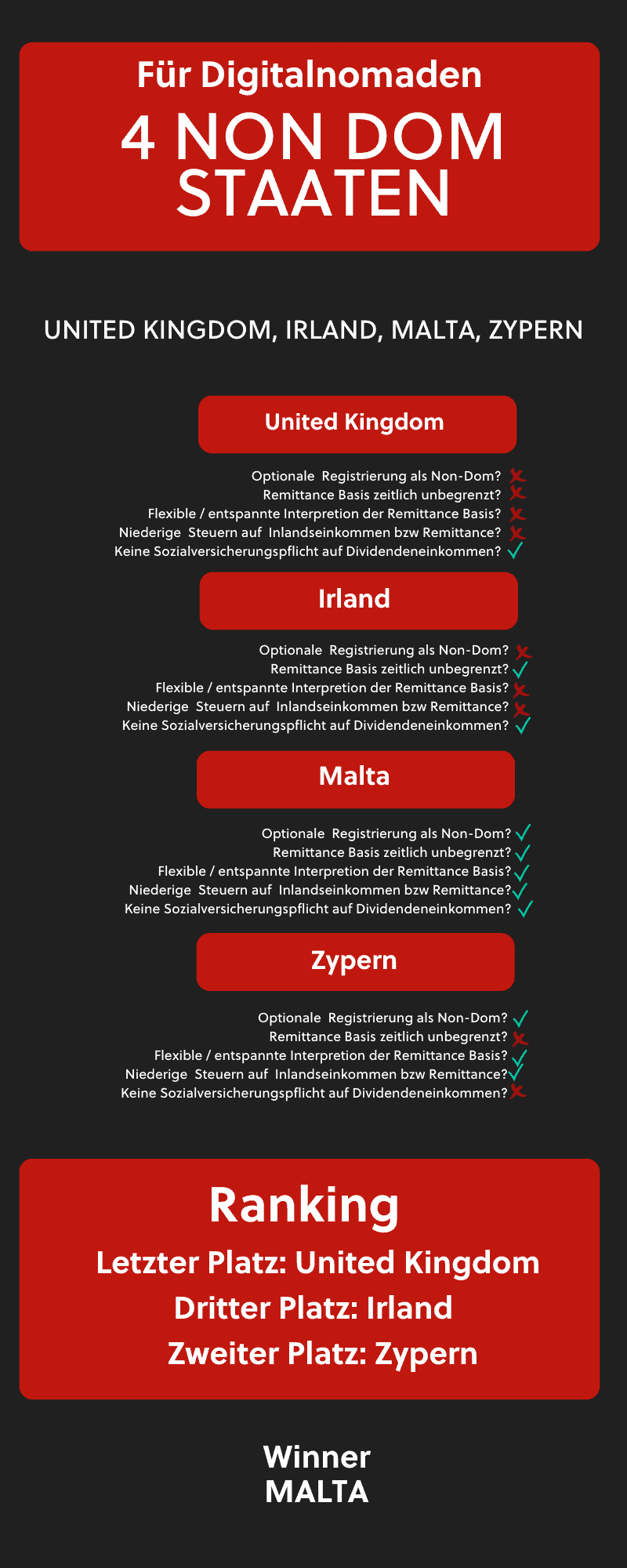
Cyprus, Malta, the UK, and Ireland
The experts among you will spot the pattern immediately: These countries have something in common. They all utilize the "Non-Dom Status" and the "Remittance Basis of Taxation." This concept from private international law alone tells you something about the tax policy of these nations. They offer tax incentives to attract foreigners to move to "their" country.
Even without diving into the details yet, this indicates a generally positive political alignment and ideology toward expats. These four countries are the UK (the "homeland" of the Non-Dom status), Ireland and Malta (heavily influenced by the UK system), and more recently, Cyprus.
Let's Talk Plain English: What is Non-Dom?
In the UK, Malta, Ireland, and Cyprus, a person is considered either "Domiciled" or "Not Domiciled." This term can be slightly misleading because people often confuse it with residence, abode, or where you currently live. While those factors play a role, "Domicile" in this legal context goes much deeper.
What it means:
Think of the difference between "House" and "Home." That's the best way to explain the concept. Home is more than just a house. Home asks about your roots. Your place of birth. Your parents. It's a place whose validity isn't defined solely by your physical presence.
Non-Dom equals No Roots
It's important to understand that DOMICILE or NON-DOMICILE is often not strictly defined in tax law statutes. However, legislators in our four countries use the term to categorize a specific group of people. If you aren't "rooted" there, you aren't domiciled there.
Let's get concrete.
Imagine you've just moved to the UK, Ireland, Malta, or Cyprus. Imagine every new arrival has an interview at the tax office. The officer has your file in front of him and two large rubber stamps on his desk. One says "DOMICILED," the other says "NOT DOMICILED."
The officer asks you:
Answer these questions in your head. If any of your answers establish a strong link or bond with the officer's country, you might have a problem. But let's assume you come from Germany (or another country outside these four).
- Where were you born?
- What is your parents' nationality?
- Where did you grow up?
- Do you intend to marry someone from our country?
- How long do you intend to stay here?
Your answers would be:
- Germany.
- German.
- Germany.
- No.
- Max 10 years.
The officer picks up the "Not Domiciled" stamp and slams it onto your file with practiced ease.
Further down, we'll use these questions and sample answers to compare the Non-Dom countries directly.
But before that, let's talk about what "Not Domiciled" actually means for your wallet—specifically the "Remittance Basis of Taxation." The Non-Dom status is really just the ticket that gets you access to the Remittance Basis.
Non-Dom Status – A Definition
In essence, all these countries define it similarly: "A person who is resident but not domiciled is only taxable on income that is derived in or remitted to our country."
This means:
A resident but non-domiciled person only pays tax on income earned within that country, or income transferred (remitted) to that country.
There is a lot of truth in that sentence, but also a lot of room for interpretation.
The easy part:
Earning money inside the country is clear. "If you earn it here, you pay tax here."
The tricky part:
What does "remitted" mean? The term is broad. It usually translates to "brought in," but that sounds like we're only talking about cash in a suitcase. There isn't always a single, rigid definition for Remittance; it's often decided by the tax administration's interpretation. How the local tax office interprets this should be a major criterion for your choice of country.
The Remittance Catalogue (Examples)
- Bank Transfer from abroad to a local account.
- Cash brought from abroad (nothing to do with the 10,000 EUR customs limit at the airport—this is about tax).
- Paying bills or credit cards in the country using foreign funds.
- Luxury goods bought abroad and brought into the country (e.g., cars, jewelry, watches, fashion, handbags, gold, diamonds, etc.).
- Paying for a local house using money held abroad (constructive remittance).
- Paying off a local loan using money held abroad.
The Officer's Questions – A Country Comparison
Let's go back to your interview. Imagine you have this appointment in all four countries. The first five questions and answers are the same as above (you are a foreigner with no intent to stay forever). I've added the officer's likely comments regarding the interpretation of Remittance, registration duties, and social security on dividends.
1. UK
- Officer: "Important update: The classic Non-Dom system with the Remittance Basis was abolished in the UK as of 6 April 2025. It has been replaced by the new FIG regime (Foreign Income and Gains), which only applies for a maximum of 4 years—and only if you have not been UK tax resident for at least the previous 10 consecutive tax years. After that, you will be taxed on your worldwide income."
- Officer: "Under the new system, you must actively claim the FIG relief in your tax return."
- Officer: "Taxes in our country for income earned here are 'normal'—meaning high, up to 45%."
- Officer: "You are not liable for social security on dividend income."
2. Ireland
- Officer: "Okay, there is no time limit on the Remittance Basis of Taxation here."
- Officer: "We interpret 'Remittance' strictly."
- Officer: "You generally don't need to formally register as a Non-Dom in the same way."
- Officer: "Taxes in our country for income earned here or remitted here are 'normal'—up to 40%."
- Officer: "You are not liable for social security on dividend income."
3. Cyprus
- Officer: "The Non-Dom status applies for a maximum of 17 years (17 out of the last 20 tax years). For your planned 10-year stay, you are safe. Note: Cyprus does not use a classic 'Remittance Basis'—as a Non-Dom, you are exempt from the Special Defence Contribution (SDC) on dividends and interest (normally 17% and 30% respectively)."
- Officer: "You don't need to register as Non-Dom to get the benefits."
- Officer: "Taxes in our country for income earned here or remitted here are low—0% to 15%."
- Officer: "However, you are liable for GeSY healthcare contributions on dividend income (2.65%, capped at EUR 180,000 annual income)."
4. Malta
- Officer: "Okay, there is no time limit on the Remittance Basis of Taxation."
- Officer: "We do not interpret 'Remittance' strictly or pedantically."
- Officer: "You don't need to register as Non-Dom; it's your default status as a foreigner."
- Officer: "Taxes in our country for income earned here or remitted here are low—0% to 5% effective rate."
- Officer: "You are not liable for social security on dividend income."
- Officer: "Important: There is an annual minimum tax of EUR 5,000 for Non-Doms whose foreign income exceeds EUR 35,000."
Analysis and Ranking
This ranking looks exclusively at the tax aspects. Naturally, you will have personal, family, social, and commercial reasons for choosing a country. Preferences regarding politics, environment, size of the island, and lifestyle are up to you.
I think it's fair to say that all of "my" listed countries offer an acceptable standard of living.
4th Place: UK
The motherland of the Non-Dom status takes last place in my ranking. For one, the UK is no longer an EU member. Secondly, the classic Non-Dom status with Remittance Basis was completely abolished on 6 April 2025. It was replaced by the new FIG regime (Foreign Income and Gains), which only lasts 4 years and is only available to new arrivals who were not UK tax resident for at least the previous 10 years. Consequently, the high tax on locally earned income, paired with the now massively restricted tax benefit, makes the UK the least attractive option. Plus, let's be honest—it rains constantly and it's cold.
3rd Place: Ireland
Often not immediately recognized as a Non-Dom country, Ireland follows the UK closely. It ranks higher solely because the taxes are slightly lower and there isn't the same aggressive time limit/charge structure as the UK. The biggest negative point remains: High taxes on income earned in or remitted to Ireland. The weather is arguably just as bad as the UK.
2nd Place: Cyprus
Cyprus takes second place because its Non-Dom program is relatively young (and limited to 17 years). Taxes are very favorable, especially regarding income earned IN Cyprus. However, there is a "hidden" levy in the form of social security contributions (Gesy) on dividends. Also, for me personally, the Greek alphabet and language barrier is a bureaucratic thorn in the side—a small disadvantage compared to English-speaking jurisdictions.
1st Place: Malta
Malta takes first place in my ranking. From a purely tax perspective, the following aspects tip the scales:
- The Remittance Basis exists, but you don't really need to rely on it or play hide-and-seek with your money.
- You can earn all your income officially in Malta. The most effective way to do this is by forming a company in Malta.
- With a Malta Limited, you generate your income officially on an EU tax return. You don't need to worry about "remittance" rules because you are taxing it locally.
- With the right structure in Malta, you achieve a total effective tax rate of 5%.
- Social security is the lowest of all 4 countries in this comparison. Additionally, English is an official language in Malta, which makes life and business significantly easier.
FAQ
What is the main tax problem for a digital nomad?
The main issue is "not fitting the pattern." By not having a clear tax residence, you risk waking sleeping dogs and becoming legally vulnerable in high-tax countries that might claim you.
What is the biggest disadvantage of being a digital nomad?
The biggest downside is often compliance. You might fail to meet the requirements of business partners because you can't provide a tax number, a fixed address, or a registered company. This makes you look high-risk.
Can banks close my account if I don't have the right documents as a nomad?
Yes. It is entirely up to the bank to decide who gets to keep an account. If you trigger their compliance alarms by having no fixed residence, they can offboard you.
Being a digital nomad is legal, right? Why is it a problem?
It's not about legal vs. illegal; it's about easy vs. difficult. It's about the effort required to do business with you. For a client or a bank, you are hard to "categorize," which creates administrative work and risk for them.
What is the solution for nomads facing bank or client issues?
A solid solution is taking up residence in a country like Malta. The local requirements for residence are manageable, and you can still travel freely. However, this usually only works effectively in combination with forming a Malta company to provide the necessary substance.
Disclaimer: The content of this article is for general information purposes only and does not constitute tax, legal or financial advice. Despite careful research, we make no guarantee for the accuracy, completeness and timeliness of the information provided. Tax regulations are subject to constant change. For individual advice, please consult a qualified tax advisor. Use of the content is at your own risk.
Stay Informed
Receive our latest articles on international tax planning, relocation and company formation directly in your inbox.
No spam. Unsubscribe anytime.
