Taxes in Malta: The Complete Guide for 2026
Last updated: 1 March 2026

Malta: tax haven, offshore paradise, low-tax jurisdiction. You've heard the names. The tax authorities back home certainly have their own names for it, too.
But here is the elephant in the room:
Malta is a full member of the EU. That means it has every right to determine its own tax policies. You don't hear that part mentioned quite as often in the media.
When people talk about taxes—especially low taxes—the discussion often splits into two camps and quickly becomes a moral debate. But in my line of work, tax law isn't about morality.
Let's be honest: in 99% of cases, every country collecting taxes and every person paying them is trying to do the exact same thing—maximize their return.
It’s not a question of legal vs. illegal.
Tax evasion is neither legal nor moral. That's clear. But if you stick to the established rules, you don't need to face any moral inquisition.
That's why I'm not writing this article to judge. Within the EU, every citizen has the same legal options available to them. Whether you want to—or can—use them is up to you.
What this article is about:
Taxes in Malta: 100% Facts.
Here is a fact: A competitive tax rate alone does not make a country a "tax haven." From the perspective of high-tax countries like Germany or France, almost anywhere else could look like a tax haven.
However, I’m not going to sugarcoat it. Malta was, for a long time, a "sort of" tax haven. Then it joined the EU. Unexpectedly for everyone involved, Malta was rewarded with massive success thanks to the rapid rise of the digital economy.
Was there political turmoil and scandal? Yes, that is a fact. Is it true that Malta used to be less strict with financial administration? Yes. But that has changed. Today, Malta is strict. The authorities here even buy tax-evader data CDs from places like Dubai.
Due to pressure from the EU, Germany, France, and the UK—alongside OECD measures and transparency registers—there have been plenty of attempts to rain on Malta's parade. It hasn't worked. Malta is booming. The price we pay for keeping our attractive tax system is simply higher compliance and stricter rules.
But let's get back to the point:
We aren't here to talk about compliance. We're here to talk about tax.
Let's let the cat out of the bag.
Malta charges 5% tax. Fact.
But let's take this step by step. Just throwing that number out there doesn't explain how it works. We need to start with the basics.
Malta Income Tax – The Only Tax on Profits and Income
When you hear "Income Tax," you probably think of the tax you pay as an individual. That's correct, but in Malta, both individuals and companies pay the exact same tax: Income Tax.
I’ll cover personal income tax further down—including the brackets and how capital gains are handled if you are an employee or sole trader.
But first, the corporate side.
In most countries, an entrepreneur is taxed at least twice. If you've ever run a company in the UK or Germany, you know the drill. In Germany, you might get hit three or four times:
- Trade Tax (Gewerbesteuer)
- Corporate Tax (Körperschaftssteuer)
- Income Tax or Capital Gains Tax on dividends
- Surcharges (Soli)
In Malta? You are taxed once. Because there is only one tax.
You might be wondering how that works.
Question 1: Is a Malta Limited essentially the same as a UK Ltd or a German GmbH? Answer: Yes.
Question 2: Does a Malta Limited have its own legal personality? Answer: Yes, it does.
So how can it only be taxed once? The answer lies in the Full Imputation System. This is the most critical feature of the Maltese tax landscape.
The Full Imputation System – Taxed Only Once
The logic is simple: the same income cannot be taxed twice. If a Malta Limited has already paid tax on its profits, the shareholder cannot be taxed again when that profit is distributed as a dividend.
This is where the moral crusaders usually get confused.
Here is what most people don't understand:
Malta charges 5%, correct. But the system was designed with the assumption that another country would tax the individual later. If you pay 5% in Malta and then pay another 25%+ on dividends back in your home country, your total tax bill is over 30%. Is that really a "tax haven" result?
If you don't live in Malta:
You might think, "Well, maybe the tax man back home won't find out I have a Malta company." Can you hide it?
Not really. Banks automatically report balances to tax authorities via CRS (Common Reporting Standard), and the Transparency Register makes ownership public. If you try to hide it, you are playing a dangerous game.
If you DO live in Malta:
Admittedly, if you live here, the game changes. You pay the 5% corporate tax, and that's often it. You could call that a low-tax environment. Once you are a resident here, it is solely up to Malta how much tax is collected. No other country has a claim on your income.
Back to the mechanics:
The standard corporate tax rate for a Malta Limited is 35%. A local Maltese business owner pays this 35% and then pays nothing personally on the dividend, because the tax has already been paid by the company.
The same principle applies to international shareholders. The difference is that Maltese law recognizes that a foreign shareholder (or a holding company) isn't liable for standard Maltese tax rates. This is where the Tax Refund comes in.
Note: In this context, "foreign" can also mean a structure owned by you, even if you live in Malta. Typically, if you move here, we set up a foreign entity (a Holding Company) outside of Malta to receive the dividends and the refund.
The Malta Tax Refund
If the shareholder receiving the dividend is not a Malta resident (or is a qualifying holding company), Malta refunds a massive portion of the tax paid. Specifically, 6/7ths of the tax is refunded.
To put it plainly: You pay 35%, and Malta gives you 30% back. The effective tax rate is 5%.
While you can still use the old method—paying the full 35% and waiting months for the refund—it creates a cashflow problem. The application is tedious and processing takes time. That is why most of my clients now use Fiscal Consolidation.
Fiscal Consolidation – 5% Tax Without the Cashflow Hit
You might know consolidation from other jurisdictions. It allows you to form a "tax group" so you only pay tax at the group level.
In Malta, this usually involves two companies: a Malta Trading Ltd and a Malta Holding Ltd.
The Malta Holding pays the tax for the group. Here is the "pro move": Since the Holding is entitled to the refund we mentioned earlier, it can offset that refund against the tax due immediately. It doesn't pay 35% and wait for a check. It simply pays the net 5%.
Why the Imputation System Matters
Malta taxes dividends only once—in the hands of the company distributing them. Let me give you another example of how consistent this logic is:
Suppose you live in Malta and own 100% of a German GmbH or UK Ltd. That foreign company pays its corporate tax and distributes a dividend to you in Malta.
Malta will generally not tax this income again in your hands, because it has already been taxed at source. But the system goes further.
Malta rolls everything into ONE tax
Malta adds up all taxes that are similar to its own. If you look at the tax burden of a German GmbH (Trade tax + Corporate tax), it exceeds the Maltese 35% rate.
Since the tax paid abroad is higher than what would be due in Malta, no further tax is due here. It’s a credit system that actually works.
No Withholding Tax
For the same reason, Malta does not charge withholding tax when a Malta Limited distributes a dividend. It doesn't matter if the shareholder is an individual in Monaco or a Holding in Jersey—the principle of "taxed once" stands.
This makes Malta an incredibly interesting location for Holding companies.
Personal Tax in Malta
We've covered the 5% corporate structure, which works for dividends. But what if you are a freelancer or a sole trader? A dividend can only be paid by a limited company.
The 5% effective rate is NOT available for sole traders.
As an individual in Malta—whether self-employed or an employee—you fall under progressive tax brackets. There are incentives, which I'll mention below, but generally, you pay standard rates.
Progressive Income Tax
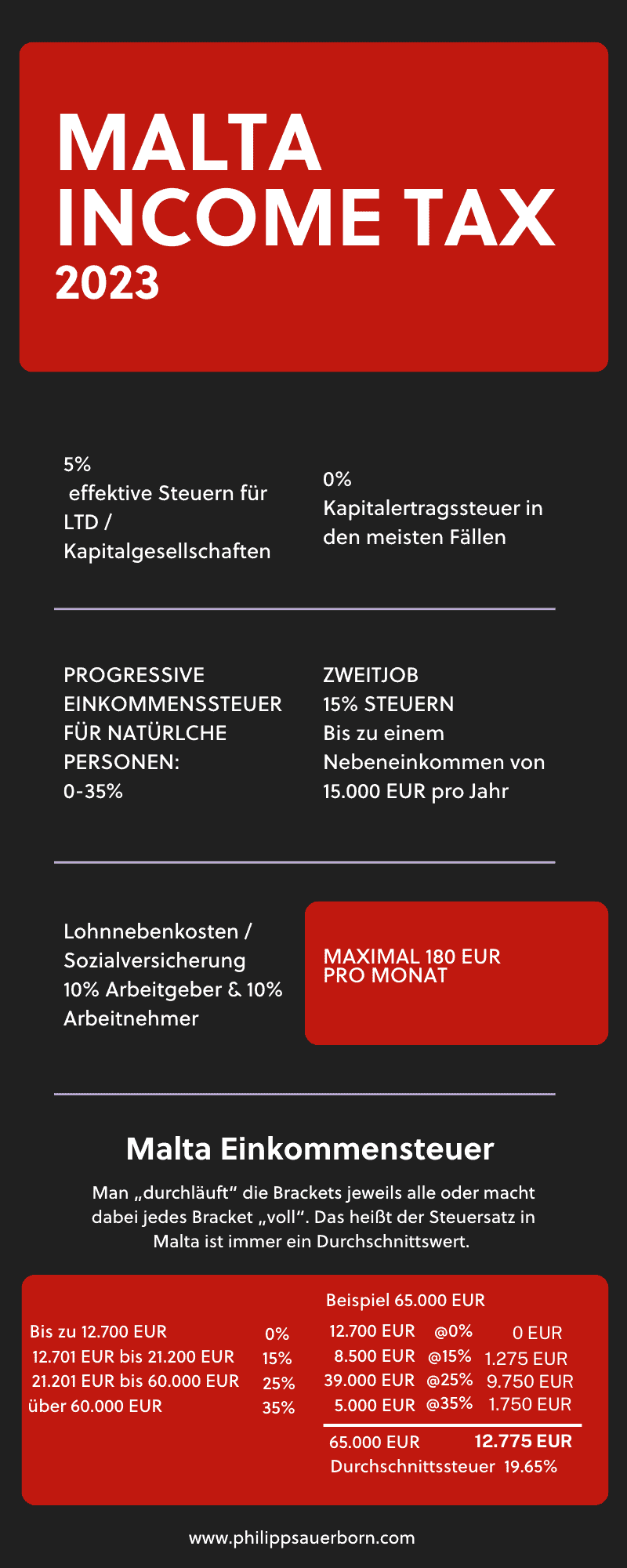
Malta uses tax brackets. You pay a specific percentage for each chunk of income.
How it’s calculated:
Unlike some countries where hitting a higher bracket means your entire income is taxed at that rate, in Malta you move through the brackets. Your total tax is an average.
Let's look at an example of earning €65,000 per year.
Current Tax Rates (Single Rates)
| Income Bracket | Tax Rate | Example Calculation (€65k) | Tax Due |
|---|---|---|---|
| €0 to €12,700 | 0% | On first €12,700 | €0 |
| €12,701 to €21,200 | 15% | On next €8,500 | €1,275 |
| €21,201 to €60,000 | 25% | On next €38,800 | €9,750 |
| Over €60,000 | 35% | On remaining €5,000 | €1,750 |
| Total | €65,000 | €12,775 |
In this example, the total tax is €12,775, which is an average tax rate of roughly 19.65%.
Social Security (National Insurance)
Just like in the UK or Germany, there is a share for the employer and the employee. It is roughly 10% of the gross salary for each.
This "Social Security" covers free healthcare, maternity leave, the state pension, and unemployment benefits.
While the state pension here isn't exactly a fortune compared to Northern Europe, the contribution is much lower. In fact, it's capped.
The Social Security Cap
In Malta, there is a maximum amount you can pay. For a standard employee, the cap is roughly €56 per week (approx. €2,900 per year) for the employee, and the same for the employer.
Once you earn over roughly €29,000 a year, you stop paying more social security. This leaves you with significantly more net income compared to high-tax countries where social security scales almost indefinitely.
Capital Gains Tax
First, the good news: Foreign capital gains are generally exempt from tax in Malta for non-domiciled residents (which you likely are if you moved here), even if remitted to Malta. Note: This applies to capital gains, not income (dividends/interest).
Important: This does not apply to income from professional trading or business activities.
For Maltese capital gains (e.g., selling Maltese shares), the tax is generally a flat 15% or 35% depending on the nature of the asset, though specific rules apply.
Property Tax:
If you sell property in Malta, it falls under a withholding tax system:
- If you sell your own residence after living in it for 3 years: 0% tax.
- Otherwise, a Property Transfer Tax applies (usually 8% or 5% depending on when it was bought and sold).
Tax on Pensions
Pensions are complex. They involve lump sums, early retirement, and international Double Tax Treaties.
A general rule of thumb: State pensions are usually taxed in the country that pays them and are not taxed again in Malta. Private pensions often depend on the specific tax treaty between Malta and your home country.
The 15% Tax on Side Hustles
If you are employed full-time in Malta and start a side business or part-time self-employment, there is a great incentive. On the first €12,000 (approx) of profit from that side job, you only pay a flat 15% tax.
Personal Tax Returns
The rule is that every individual files a "Self Assessment" once a year. It’s a simple form—usually just a few pages.
For the Self-Employed: You must file a return and pay tax annually. You attach a Profit & Loss statement. You generally don't need a full audit for a sole trader setup.
For Employees: If your only income is your salary, the tax is deducted at source (FSS). Often, you won't even need to file a return unless your income situation changes.
Conclusion
Malta's Full Imputation System is the reason we can achieve a 5% effective tax rate. This system ensures that income is never taxed twice. However, to access the 5% rate, you need a company structure (Malta Limited). If you operate as a sole trader, you are stuck with the standard progressive rates of up to 35%.
Moving to Malta and Setting Up a Company
To truly leverage the benefits of the imputation system, moving to Malta is often the best move. With the right structure—specifically using fiscal consolidation—you can live in the sun and legally pay an effective corporate tax rate of 5%.
If you are considering the move, get in touch. We can look at your specific situation to see if the Malta model fits your business.
Disclaimer: The content of this article is for general information purposes only and does not constitute tax, legal or financial advice. Despite careful research, we make no guarantee for the accuracy, completeness and timeliness of the information provided. Tax regulations are subject to constant change. For individual advice, please consult a qualified tax advisor. Use of the content is at your own risk.
Stay Informed
Receive our latest articles on international tax planning, relocation and company formation directly in your inbox.
No spam. Unsubscribe anytime.
