Moving to Malta: The Complete Expat Guide (2026)
Last updated: 10 February 2026

As of February 2026 – Malta currently has around 574,000 inhabitants (NSO Malta, 2024), an effective corporate tax rate of 5%, and offers a straightforward relocation process for EU and international citizens. This guide covers the nine most important points: from the ID Card and taxes to schools, the housing market, healthcare, transport, and culture.
Welcome – Your Path to Malta
So, you’re thinking about moving to Malta?
I’m glad to hear it. In any case, you’ve come to the right place…
…I’ve summarised the most important information on the topic of “Living in Malta” for you right here.
But let’s not waste any time—let’s dive straight in.
I’m pleased you found your way to my blog and that you’re considering making the move.
When I ended up here back in 2011, I was a bit sceptical at first. But my concerns vanished in no time at all.
Believe me: Living where others go on holiday isn’t just a cliché. Sun, warm temperatures, the sea right on your doorstep, and so much more. Malta is worth it.
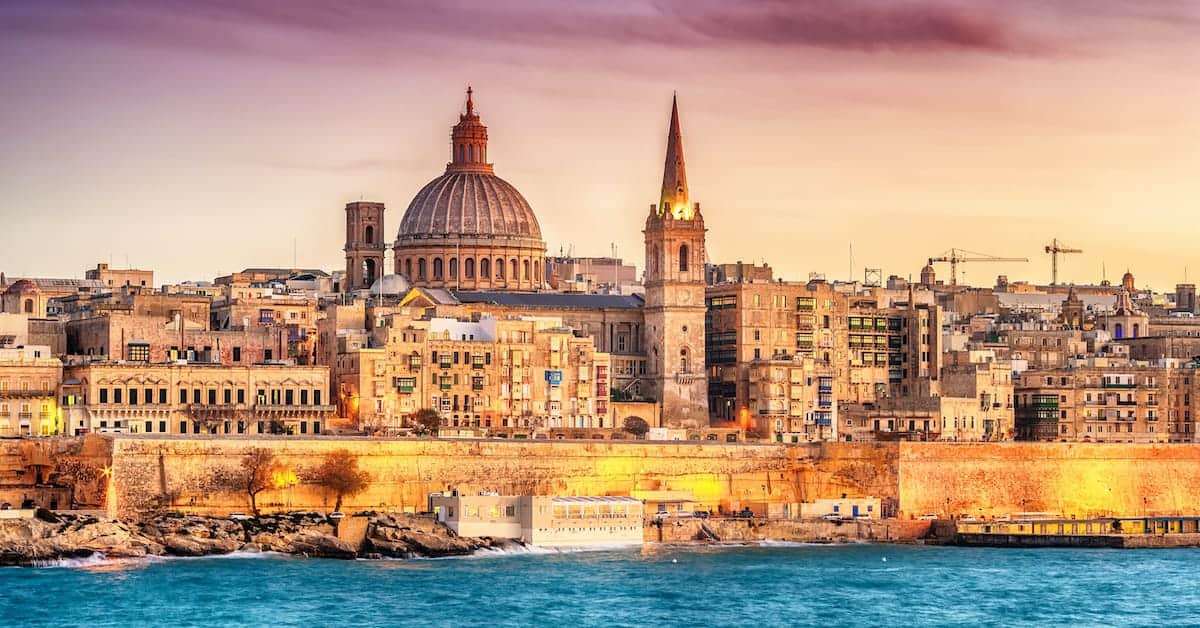
The fact that you’re thinking about this in advance is commendable. Emigrating impacts almost every area of your life, and a step like this needs to be well thought out.
In my work at the law firm Dr. Werner & Partners, I often meet interested parties who haven’t looked into the country at all and are only focused on the tax advantages.
I’m sure you’ve heard about Malta’s tax benefits—like the 5% tax system of the Malta Limited. It’s absolutely legitimate for these to play a major role in your decision. However, for me, it’s always important to say:
Tax benefits shouldn’t be the only reason.
If you don’t like warm temperatures, or if the Maltese philosophy of life feels alien to you, you won’t be happy here.
That’s why I haven’t just highlighted tax aspects in this list, but also looked at the country itself. This way, you can get a complete picture of the island state of Malta.
I’m happy to share my insights with you. If questions arise, feel free to write to me using the contact form at the end of the page.
And if you need further advice, we can always meet for a coffee at the Dr. Werner & Partners offices.
Greetings from sunny Malta, Philipp M. Sauerborn
Malta at a Glance
- EU Member since
- 2004
- Official Languages
- Maltese & English
- Population
- 574,250 (NSO Malta, 2024)
- Area
- 316 km²
- Ø Temperature
- 23 °C
- Currency
- Euro (€)
- Effective Tax Rate
- 5 % (Income Tax Act, Cap. 123)
- Flight from London
- approx. 3 hours
Malta ID Card: A Must-Have on the Island
Don't skip this: The Maltese ID Card opens many doors.
Now, let me explain why you should get this little card. Or rather, why you must. Anyone who stays in Malta for 3 months a year—so, 90 days—is required to apply for a residence card.
First, a technicality: What actually is the Malta ID Card?
You can compare it to a national ID card. Although, legally speaking, a UK or German passport has a bit more "oomph."
The Malta ID is a "national ID card" (or Residence Card for non-Maltese) and is a fully valid official state document of the Republic of Malta for identification.
However:
When you hold the ID Card in your hands, don't try to use it at the airport to travel internationally (unless you are a Maltese citizen). No airline I know accepts the Residence Card as a travel document. It proves residence, not citizenship. That's what I mean when I say your passport has more "oomph."
But for identifying yourself within Malta, I've never had any issues with it.
How to get the Malta ID Card – Legal Requirements
To apply for the Malta ID, you generally need to fulfil one of the following criteria. You must be:
- Employed
- Job seeking, registered as such with the Maltese employment agency JobsPlus (unemployed)
- A social security beneficiary in Malta
- Economically Self-Sufficient (Privatier)
For this article, I'll focus on requirements 1 and 4.
Gather Documents(1 week)
Employment contract or proof of self-sufficiency (EUR 14,000 bank balance, EUR 23,000 for married couples), health insurance, rental agreement form
Submit via Email(1 day)
Send all documents to eu.ima@gov.mt (for EU citizens) or the respective TCN department. Check identitymalta.com for the list
Photo at Identity Malta(2–3 weeks wait)
Personal appointment at the Head Office in Msida. Tip: EU citizens use the side entrance on the left
Collect ID Card(another 2–3 weeks)
Collection slip arrives by post. Then head back to the Head Office to pick up your new card
Malta ID Card as an Employee
This is by far the most common form of Malta ID application I've supported. This is because most clients I work for set up a Malta Limited company and then employ themselves at this company. This is completely legal and a standard, accepted procedure.
Employment has the unique advantage that you can easily and quickly get the documents you need for the Malta ID Card application:
The signed employment contract and the registration of the employment, along with the ID Card application itself.
Malta ID as Self-Sufficient (Privatier)
You need a current bank statement showing EUR 14,000 cash in the account. If you are married, this amount must be at least EUR 23,000.
Plus EUR 2,400 per family member.
You must also prove you have private health insurance that covers you in Malta—not as a tourist, but as a resident.
Why the Malta ID Card is Mandatory
Well, firstly, as mentioned above, there is a legal obligation.
Secondly, your Malta ID Card number becomes your central "super number" on Malta. It serves as your tax number, is used for your driving licence, and is asked for at doctor or hospital appointments. Furthermore, no bank appointment is conceivable without the ID Card.
Above all, it is a very effective document to prove that you actually live in Malta.
It also helps you get significantly cheaper bus tickets or even borrow books from the library. While applying for the card is often a test of patience (I could tell you stories!), given the benefits, it's a must for every Malta expat.
Equally important: Your landlord must confirm that you are the tenant of their apartment. There is a specific form for this. If you are a home owner, you must register your property accordingly.
The Background:
In the past, dozens of people were often registered in one household just to fake a residence in Malta. To put a stop to this and keep track of how many people live in which household, there is now a strict rental declaration form.
Where do you get the ID Card?
You get the ID Card at the Identity Malta Head Office in Msida (Identity Malta Agency Head Office Valley Road, Msida, MSD 9020). The process has changed a bit since Covid: Currently, the necessary documents must be sent by email. You can find a list of all necessary documents at Identity Malta.
The photo is taken at the authority's Head Office.
About two to three weeks later, you will receive a letter with a collection slip. With this slip, you can then—who would have guessed—pick up your new ID Card.
The whole procedure can easily take two months. For the time until then, you can get by with your existing passport.
Tip: The Identity Malta building is relatively new and large, with the agency's logo on the side. EU citizens usually use the side entrance on the left of the building.
Online Services with Maltese eID
One thing I see as a huge advantage in Malta's public sector is that digitalisation is quite advanced here. Many bureaucratic processes take place entirely digitally and are managed centrally via a login linked to your ID Card.
Be it your personal taxes, the VAT return for your company, or even your entire medical record—it's all managed online with one login.
Note: As part of the relocation package at Dr. Werner & Partners, our staff handle the ID Card application and communication with the authorities for you.
The Maltese Healthcare System – How Good Is It?
When it comes to the Maltese healthcare system, for many years you didn't hear good things. And I won't exempt my own blog from that in the past.
The good news:
A lot has changed.
Before I talk about the conditions, I want to explain the basic system first. It's different from what you might be used to in the UK or Germany.
Naturally, before emigrating to Malta, you want to know what the medical care is like.
And I can report that compared to many other countries I've lived in or visited, Malta performs comparatively well.
However, compared specifically to the UK NHS or the German system, the mechanics are different. Let me put that into perspective.
| Public (Malta Health) | Private (Self-Pay) | |
|---|---|---|
| Access | Payslips from last 3 months | Immediate, no prerequisites |
| Cost | Free (via SSC contributions) | EUR 5–30 per visit |
| Wait Time | Often several hours | Short to none |
| Emergencies | Mater Dei Hospital | Referral to Mater Dei |
| Billing | Via Social Security Contributions | Direct payment on site |
| Insider Tip | – | Private doctors in pharmacies (EUR 5–15) |
Public Health Insurance? Not exactly.
The system in Malta is a state healthcare system called "Malta Health". Similar to the ID Card, there are requirements to participate:
You must have a job in Malta with a monthly payslip.
Or
You must be registered in Malta as unemployed or a social security beneficiary.
This is a key difference from the NHS in the UK. In the UK, residence is the main criterion. In Malta, you are regularly asked for the payslips of the last 3 months when it comes to using the state health service for free.
There are no statutory health insurance funds like in Germany or the Netherlands. But you also don't have those relatively high monthly deductions directly from your wage.
You only pay SSC in Malta – Social Security Contributions. For employees, the rate is 10% from the employee and 10% from the employer (total 20%); self-employed people pay 15%.
These contributions are significantly cheaper than social security costs in many other European countries.
This means there is more net left from the gross. However, the public, free care is organised very strictly and centrally.
But honestly:
If you do it like I do, the difference might not even be noticeable to you. I recommend a split. A distinction between minor and major "ailments".
For the small ones, go as a self-payer to private providers like private doctors or private hospitals.
For the big ailments, you can also be treated privately. There is even private health insurance in Malta. But: Medically, for real emergencies, there isn't really a choice. Because if there's a serious complication in the best private hospital in Malta, you would be transferred immediately to Malta's central main hospital anyway.
To Mater Dei Hospital – Malta's main hospital in Msida, in operation since 2007, with 825 beds, 25 operating theatres, and 250,000 square metres of space.
Therefore, the choice might as well fall directly on the state system if you are planning an operation. Or a birth.
And the example of birth explains it best.
When my daughter was born, we thought about a private delivery. The costs were around EUR 2,500 compared to the state system. A manageable price.
But then came the statement:
"If something goes wrong, mother and child will be taken to Mater Dei Hospital."
Well. That means I go private only to potentially end up worse off because there's an ambulance transport of about an hour if things go south?
We decided on public care, meaning a delivery at Mater Dei Hospital.
And the experience and result were top-notch, hats off.
However, coming back to the big and small ailments. If you need a prescription or have a twisted ankle and want to use state care, namely one of the Health Centres or the Mater Dei A&E:
Be prepared for long waiting times.
But if your time is precious, I recommend the many private options for the little "ouches". There, you will be treated quickly and well for a fee of EUR 5–30.
Private options include:
- St James Private Hospital in Sliema
- One of the many established private practices, e.g., the Verdana Clinic in Msida
Malta's Healthcare at a Glance
- Free access to most medical services if you pay Social Security
- Most pharmacies have a doctor's practice integrated
- Mater Dei is the largest hospital; others have different specialisations
- Care is good, but waiting times in the public sector are longer than in private
Trick 17: The Doctor in the Back of the Pharmacy
Perhaps you've been to a pharmacy in Malta and wondered why there are chairs with people waiting. These people aren't waiting for the pharmacist, but for a doctor.
Most private doctor's practices are located in pharmacies. There you will find GPs or specialists. Usually, doctors rotate by day of the week in the pharmacy and by week from pharmacy to pharmacy.
With or without an appointment:
It makes sense to make an appointment with the pharmacy, especially if you need the advice of a specialist. But if it's urgent:
It works without one too.
That means: You can show up without an appointment, register for an examination, and after a short wait, it's your turn. No patient file is kept on you locally; this is all done via a central system (eHealth).
Cost point: between 5 and 15 Euro, payable after treatment in the pharmacy. Information on opening times and attending doctors can be found on the website Pharmacy.com.mt.
A tip here: Pharmacy and doctor naturally promise each other a certain interaction.
Meaning: Your doctor will probably always prescribe you something, even if it's just vitamins. It's up to you whether to buy these vitamins or not. But you should healthy question whether you really need the remedy.
Emergency Care: Mater Dei is the largest hospital in Malta.
And believe me: It is large even by international standards.
Besides Mater Dei, there are other hospitals on the island with different purposes:
- Mater Dei Hospital (L-Isptar Mater Dei), Msida, Emergency and Teaching Hospital
- Sir Anthony Mamo Oncology Hospital, Msida, Oncology Clinic
- Karin Grech Hospital, Pietà, Rehab Clinic
- Sir Paul Boffa Hospital, Floriana, specialised for Oncology, Palliative Medicine, and Dermatology
- St. Vincent De Paul Residence, Luqa, Long-term care
- Mount Carmel Hospital, Attard, Psychiatric Clinic
- Gozo General Hospital, Victoria Gozo, General Hospital
Especially those living in the St. Julians and Sliema area will usually be treated at Mater Dei if necessary.
Now to the quality of treatment:
The waiting times are definitely unpleasant. If you are not classified as an emergency, you often have to wait hours to be treated.
I know this isn't unique to Malta, but you should know that you'd better keep days free when you need to be treated at Mater Dei.
The quality of treatment itself has improved greatly in my eyes. I am not a doctor, so my assessment is purely subjective. Although I haven't been in treatment for long myself, my brother, who also lives in Malta, unfortunately had to visit the hospital for a few days.
In his experience, the care is really good. The staffing levels are high, and the staff take a lot of time for their patients.
The equipment is by no means outdated. So you really don't have to worry here. Unless you are a gourmet. Then you will definitely struggle with the hospital food.
Moving to Malta – What the Taxman Says
Am I affected? Quick Check
- Business Owners: Moving a company involves "exit tax" risks depending on where you are moving from. The UK is currently lenient, but rules are tightening.
- Freelancers / Sole Traders: Usually easier to move, but you must cut ties with your old country properly.
- Employees: Generally no tax hurdles when moving. → Skip to Schools & Housing
Your plan to move to Malta has at least one opponent: the tax authority back home.
The reason: By moving away, the state loses tax revenue…
…and as everyone knows, that's where the fun stops for the authorities.
Moving to Malta can often lead to significant tax relief.
Sure, you've heard that. But what are the consequences?
Well, you relocate your residence, are initially taxable in Malta, and the UK Exchequer (or the taxman of whichever country you were living in) comes away empty-handed.
And you can be sure:
They don't like that one bit.
The Logic Behind "Exit Taxes"
While the UK doesn't have a formal "Exit Tax" for individuals in the same way Germany or France does (where you are taxed on the value of your company as if you sold it just because you left), you are not entirely off the hook.
If you leave the UK, you need to navigate the Statutory Residence Test (SRT) carefully. If you get this wrong, you could remain tax resident in the UK even if you live in Malta.
Furthermore, there is the trap of Temporary Non-Residence.
If you leave the UK and return within 5 years, you might be taxed on certain income and gains (like selling shares or a business) that you realised while you were in Malta. The UK taxman essentially says: "If you come back too soon, we'll pretend you never left for tax purposes regarding those big gains."
Basically, it's about making it hard for you. Or even better: Making Malta less attractive.
It's about money, and all tricks are allowed.
Transparency and Substance
Today, given the digital footprints we leave behind, I don't need to point out that you cannot fake residency in Malta.
You either move completely, or you don't. You have to move lock, stock, and barrel.
Too often in the past, people pretended to live in Malta (to benefit from tax advantages) without any real substance being found here. And then the case is clear. The tax burden is shifted based on false information—a crime called tax evasion. Recently, this offence also falls under money laundering, which can have serious consequences.
Even if this practice might have gone undetected in the past, it is practically unthinkable today. Everywhere you turn in the context of tax optimisation in Malta, you encounter transparency. International financial agreements like CRS (Common Reporting Standard) have heavily curbed undetected tax evasion.
My opinion on this: Great!
I am even of the opinion that the gained transparency can be your greatest friend. Because as hinted at the beginning, your home tax authority is by no means happy that you are suddenly paying your taxes in Malta. Not infrequently, you have to prove that Malta is rightly the country where the tax burden arises.
Core Message
A permanent residence, lively business activity, and genuine value creation on site are the best arguments you can provide.
If you live in Malta, you can easily prove that real value creation takes place here.
So create substance on site, forget concealment tactics, always be honest—an approach that has proven itself and that we consistently apply at Dr. Werner & Partners.
The 183-Day Rule and Centre of Vital Interests
Interesting info for globetrotters and digital nomads: You've surely heard of the 183-day rule. This figure is always used when determining tax residency.
General assumption: Anyone who spends more than 183 days in a country has their centre of vital interests there.
What about people who don't spend more than 183 days in any country, as is often the case with digital nomads?
Then other factors are used to evaluate where the centre of vital interests lies. Surely you would agree that if someone jumps from country to country all year round, but spends three months in the summer with family in the UK, one can assume the family home is the centre of vital interests. Simply because all other places are more transient.
It's the same with Malta: It is important that the centre of vital interests is in Malta. This must be credibly substantiated. That this is difficult if you are only in Malta for two weeks a year should be obvious. But…
…significantly fewer days than 183 are sufficient, provided Malta is the home port to which you return in between.
I have never counted days or booked extra flights or paid attention to where I am and for how long.
If you want to learn more about this topic, feel free to check out my article on the consequences of residence choice as a shareholder of a Malta Limited.
Leaving the Tax Net: Don't Become a Tax Sinner
You want to move to Malta right away?
Right attitude! Nevertheless, you should note a few things, because…
…there are tax traps when emigrating, especially for business owners.
The keywords are Capital Gains and Deemed Disposal.
| Exit Tax / Capital Gains | Deemed Disposal | |
|---|---|---|
| Affects | Shareholders / Investors | Companies moving assets |
| Trigger | Leaving the country | Moving business activity |
| Calculation | Market value of shares | Unrealised gains |
| UK Context | Temporary Non-Residence Rules | Corporate Exit Charges |
| Avoidance | Move before value skyrockets | Duplicate functions instead of moving |
Let's start with the topic.
I've found that one of the biggest fears of many expats is unintentionally becoming a tax sinner.
And indeed:
Especially if you are self-employed, the tax authorities back home can put some obstacles in your way.
The reason: If you leave the country as a self-employed person, the state loses the opportunity to profit from your income.
For UK Expats: The "Temporary Non-Residence" Trap
Unlike Germany, which charges an immediate "Exit Tax" on shareholdings of 1% or more, the UK is currently more lenient on the way out. You generally don't pay Capital Gains Tax (CGT) just for leaving.
However: If you have been a UK resident for at least 4 of the 7 tax years before you leave, and you return to the UK within 5 years, you become subject to Temporary Non-Residence rules.
This means if you sell your company or shares while you are in Malta (paying 0% tax there as a non-dom, perhaps), and then move back to the UK after 3 years, the UK will tax you on that sale in the year you return. Wham, that hits hard.
To make the tax savings permanent, you generally need to stay away for more than 5 full tax years.
Legal Context (2026)
Always consult a tax advisor before you leave. The UK rules on "Split Year Treatment" determine exactly when you stop being a UK resident. Getting the date wrong by one day can cost you a whole year's worth of taxes.
For Business Owners: Moving the Company?
If you have a Limited Company in the UK (or a BV in the Netherlands, etc.), you can't just move yourself and keep the company running as is without consequences.
If you run a UK company from Malta, Malta might claim that the "Central Management and Control" is in Malta, and try to tax the company here. Meanwhile, the UK still wants its Corporation Tax.
The best strategy: Usually, it's cleaner to close the old structure or set up a new Malta Limited for your new life. This gives you the benefit of the 5% effective tax rate in Malta and a clean break from the old system.
New since 2025: Investment Funds
Many countries are tightening rules on investment funds and crypto assets when you move. Ensure your portfolio is structured correctly before you change residency.
Your Centre of Vital Interests as the Biggest Target
I already explained the 183-day rule above. Here is the practical part: What happens if the tax office doubts your residence in Malta—and how to protect yourself.
If you are confronted with the accusation of tax evasion after the move, it is usually because your home tax office alleges that you are still resident back home.
Usually, the authorities don't come around the corner with such accusations without reason; there is usually at least a rudimentary suspicion.
Maybe you were back home often in the last six months, do you still have a rented apartment, or is there still a car registered in your name? The list of possible reasons is long, and now it is your turn to prove that there is a specific reason behind all suspicions and your real centre of life is in Malta.
Tip from the Tax Advisor
It is advisable to have written proof for all connections you still have in your home country.
Does your mother live in your apartment since you emigrated, but the contracts are still in your name?
Draw up a contract with your mother.
Are you often back home for work?
Create evidence that you are in Malta even more often and that your visits are not decisively responsible for your income.
Basically, especially in the first year of emigration, it is important to meticulously record everything in writing in order to be able to immediately smash the breeze of doubt from the tax office in a worst-case scenario.
Finally, a few words of reassurance: Anyone who has fully moved to Malta will usually have no problems proving it. Mobile phone or electricity bills or the bank statement of the Maltese account are common and accepted proofs.
Schools in Malta – Compulsory Education for Expat Children
You want to move to Malta with your children?
That is also very feasible.
What you need to observe regarding compulsory schooling and which schools are recommended…
….I'll explain to you now!
When I moved to Malta with my then-fiancée, we didn't have any children yet.
That looks different today:
Today I am the proud father of two daughters aged 6 and 8, so the topic of kindergarten and compulsory schooling has gained relevance for me too.
One thing I can assure you in advance: Children have it good in Malta too.
There are quite a few kindergartens in Malta. Nevertheless, it is worth taking your time when looking for one. There are beautiful kindergartens that offer very good care without television. However, you may have to accept a longer commute.
If both parents want to work, you should also consider a nanny or an au pair. Although these are more expensive, for some, it might be the better alternative.
Topic: Compulsory Schooling.
I have often heard the rumour that there is no compulsory schooling in Malta.
That is, of course, nonsense.
Since 1946, every child must go to school until they turn 16. The legal basis is the Education Act (Chapter 327), which sets compulsory schooling from 5 to 16 years.
Here is a small overview of this obligation:
- Primary School: Ages 5 to 11.
- Secondary School: Ages 11 to 16.
- Sixth Form: The last two school years (12th and 13th year) for students aged 16 to 18 (optional but common).
For you as an expat, the next question is which school it should be. The choice is between private international schools and Malta's state schools.
| International Schools | State Schools | |
|---|---|---|
| Language | Entirely English | English & Maltese |
| Cost | Several thousand EUR / year | Free |
| Waiting Lists | Often long (esp. Verdala) | None |
| Classmates | International families | Predominantly Maltese children |
| Advantage | Softer landing for new arrivals | Deeper cultural integration |
| Known Schools | Verdala, QSI International | District schools (state) |
International Schools in Malta Cost Money
In contrast to Maltese schools, international schools offer lessons held entirely in English. In addition, children there often meet other children whose parents have also emigrated or have to change their place of residence frequently for work—being "the new kid" is a familiar concept there, which might make for a softer landing.
Disadvantage of private schools: They cost a fair bit.
Certainly the most renowned private school is the Verdala International School. But that comes at a price. Firstly, school fees are several thousand euros per child per year, and secondly, you have to be prepared for a long waiting time if you want to send your child to this school.
An alternative is the QSI International School. The school advertises that there are no waiting lists. So if you need to place your child at short notice, you should enquire here.
State Schools in Malta: Maltese is Spoken
The difference is quite simple: In state Maltese schools, subjects are partly taught in Maltese alongside the official language English.
The advantage is that children come into contact with Maltese people quickly, and this is recommended especially for people who want to stay on the island long-term. Considering that children learn foreign languages particularly quickly, state schools should also be considered.
By the way, you shouldn't be afraid of contact with the Catholic Church, as many state schools are still under the care of the church. But you should be prepared for the fact that Malta is a very Christian country anyway.
A crux on the subject of Maltese lessons: In many conversations with Maltese parents, I have learned that not all Maltese find it sensible for their children to learn Maltese. Many would prefer every subject to be taught in English. But Malta also has many traditionalists.
Renting an Apartment in Malta – Tips, Tricks and Costs
Every expat needs an apartment.
But there are a few things to keep in mind here—otherwise, it can get expensive!
Buckle up, here comes:
An introduction to the Maltese real estate market in fast-forward.
You know the drill: Moving is always associated with a lot of stress.
It's the same for anyone who has chosen Malta as their next home. However, the Maltese housing market has its peculiarities that are worth paying attention to.
Moving to Malta with lock, stock, and barrel is generally not recommended.
Most apartments you will find on the real estate market are rented furnished. A circumstance I actually really appreciate. You save yourself the long and expensive transport of furniture and can practically start in Malta from one day to the next.
But let's be clear: Don't expect great Scandi design from a catalogue. The furnishing style in apartments is usually rather spartan or the furniture is already a bit older. This is only different in relatively expensive apartments.
By the way: The Maltese love white light. That means most light bulbs are not comfortably warm as we might be used to in Northern Europe, but bright and white. Sure, it's a matter of taste, but that's always one of the first things I change.
Perhaps you still want to transport some furniture and items to Malta.
Whether you strain the cargo capacities of the airline you fly to Malta with is up to you.
My personal secret tip: Use international pallet shipping. Within a country, there are usually providers who transport pallets cheaply from A to B.
Then comes step 2: You create an account at shiplowcost.com, a logistics company from Malta that maintains hubs in many European countries.
You send orders (in your case your pallets) to a Shiplowcost hub, and the company transports them to Malta.
The total costs depend heavily on the size. For very large pallets (120x80x220), you pay about EUR 400 with doorstep delivery in Malta. It doesn't get cheaper! Shipping takes 2-3 weeks from your doorstep at home to your doorstep in Malta.
Not cheap, but definitely cheaper and, above all, more time-saving than a van trip.
Generally, looking for an apartment in Malta works a bit differently than in the UK or Germany. There, we know: if you don't have a new place two months before the old lease ends, you pace nervously in your room.
Quite different in Malta. Here, apartments often come onto the market when the previous tenant has moved out. Short-notice viewings are then required, and the deal is often closed on the same day as the viewing. And: Since the previous tenant has already moved out, you can often move in immediately.
The apartment search here usually runs through an agent—I expressly recommend this. It makes things much easier. Unlike in some countries, however, there is no exclusive right here. That means every agent feels like they are distributing every apartment—with all the pros and cons.
My tip: Commit to one agent you have a good feeling about. Switch agents until you find a suitable one. Be honest and clear in what you are looking for. And then they will be able to offer you something suitable.
Let's come to a secret tip for apartment hunting:
Dare to negotiate.
Many landlords start a bit higher with the requested rent. That is normal. Ask your agent what they think would still be possible. They are the ones who can support you in this. Especially if you rent for a longer period, e.g., sign a lease for 3 years, landlords are willing to talk because they then receive tax benefits.
But important: Never sign a long lease at the first station in Malta. Although by law you can always get out of the contract after half the term, I have rarely experienced that one stays in the very first apartment one rents.
You get to know the island first and develop an idea of the areas and know quite quickly where and how you want to live.
Therefore: The first lease should not run longer than one year!
Last but not least: Don't just look in St. Julians, Sliema, and Valletta.
These cities are the most famous and liveliest, but price/performance is a bit skewed in my eyes. If you look a bit outside—"outside" doesn't have to be more than 2-3 kilometres away from the hotspots—you get very good value for money.
San Gwan, Msida, and Gzira have developed into popular areas here. You can get a two-bedroom apartment here for about EUR 1,200 (as of 2026).
Tips for Apartment Hunting in Malta
- Apartments are usually furnished – take only the essentials (pallet shipping e.g. via TNT/Shiplowcost)
- Short-notice viewings and closing the deal on the same day are standard
- A Maltese agent protects against inflated prices
- Don't just look in St. Julians and Valletta – value for money is much better in surrounding areas
Cost of Living in Malta – How Expensive is Life?
"How expensive is life in Malta?"
I hear this question very often.
"It depends!"
I give this answer frequently and look into dissatisfied faces.
But let's put the cards on the table:
This is what life in Malta costs!
| Category | Malta | UK / Northern Europe |
|---|---|---|
| Supermarket (Weekly Shop) | Slightly more expensive (Imports) | Cheaper (due to competition) |
| Restaurant (Main Course) | EUR 15–25 | EUR 18–30 (UK) |
| Espresso / Cappuccino | EUR 1.50–3.00 | EUR 3.50–4.50 |
| Internet (Fibre, 2 Gbit) | EUR 40–60 / month | EUR 30–50 / month |
| Mobile (5G) | Slightly more expensive | Cheaper due to competition |
| Hairdresser / Services | Significantly cheaper | More expensive |
| Rent (2-bed flat) | EUR 1,200–1,500 | EUR 1,500+ (City dependent) |
According to the Numbeo Cost of Living Index (Status: January 2026), the general cost of living in Malta is lower than in London or major German cities. Sounds good—but be careful: Rents in popular expat districts like Sliema or St. Julians are catching up fast.
Different countries – different customs….
…and different prices!
You know it from holidays: Some groceries are much more expensive than at home, others cheaper. It's the same in Malta.
While housing and utilities are now at a similar level to many European cities, groceries tend to be slightly more expensive. This is mainly because a large part of the products must be imported.
And if a product is manufactured in Malta, there is often only a single manufacturer who can set the price almost arbitrarily.
Of course, it also depends on where you buy the items.
Supermarkets in Malta
There are many "mini" supermarkets like Little Greens or Spar, which have a manageable range but are usually a bit more expensive. But they are great for quickly buying a litre of milk.
There are also several larger supermarkets: For example, Pavi or Pama. Price-wise, we are moving at about the same level as a standard supermarket in Europe, but still cheaper than the mini-marts.
The keyword globalisation also applies in Malta. The discount chain Lidl has been here for quite some time and has been well received. Prices are similar to the rest of Europe. There are many branches distributed throughout Malta. Always a nice change: The "Bavarian Weeks" or "French Weeks" bringing specific products to the island.
Finally, you will encounter many small vegetable and fruit stalls. Unfortunately, as is often the case in Malta, prices are set higher for tourists. But if you go to the same dealer regularly, you won't get cheaper prices for fresh fruit and vegetables anywhere else.
And for those who like it luxurious and organic: Greens Supermarkets. These promise a great shopping experience, but the prices are really steep and clearly aimed at higher earners. The large markets advertise particularly good quality and good selection. That is also true. Just: Costly.
One thing is cheaper here than in other countries: Service industries that involve personnel. I mean, for example, hairdressers, nail salons, or massages.
| Shopping Option | Price Level | Classification |
|---|---|---|
| Lidl (Discounter) | $ | Price similar to mainland Europe |
| Smart / Towers Supermarket | $$ | Larger selection, slightly more expensive |
| Small Shops / Greens | $$$ | Good quality, significantly higher prices |
Restaurant Prices in Malta
As for restaurant visits, it is similar to Italy.
You can get an espresso in the pastizzeria next door for EUR 1.50, and you can also get a cappuccino to go for small money. Location dictates prices here. Sliema is notoriously more expensive, even if you can get cheap and delicious coffee in small pastizzerias here too.
Restaurants are priced similarly to Northern Europe, and here too there are more expensive and cheaper options. No surprises there. It is clear that restaurants in top locations with elaborate decor are more expensive just because of the ambience. It really depends on preferences here.
Clear recommendation though: Look at Google Reviews. Very general tip, I know, but due to the many tourists, a good perspective has emerged here that is not so distorted.
Update:
Restaurants have become more expensive again. Okay. But I've travelled a lot lately and I have to say honestly: The quality of restaurants in Malta has increased extremely.
But also the versatility. Rarely have I travelled to a country where there were so many different but also good restaurants in a small space.
Food Delivery Malta – Breathtakingly Fast
I don't know any country where Bolt and Wolt deliver faster than in Malta. For me, the absolute number one in speed: McDonalds. If the fast food craving ever grabs you.
Put it to the test and order McDonalds for delivery.
Often in UNDER 10 minutes, the mobile buzzes "The courier has arrived". Really impressive, really good, really unique.
Costs for Mobile and Internet in Malta
Topic Internet and Mobile:
Here you have to put a bit more on the table if you want the same quality as in the UK or Germany. Although the networks are very well developed in Malta, the tariffs have been designed differently for not too long.
While billing by data volume is common elsewhere, Maltese providers (Go, Melita, and Epic) have moved to offering unlimited data at least locally, and with good downstream. However, prices in Malta are rather higher than on the continent for a comparable package.
Everyone has to decide for themselves what speed is worth to them.
But what I was able to test sufficiently is 5G availability, and it is simply everywhere.
Sure, Malta is small. But even in the most remote corners, I always have 5 full bars of 5G.
It's the same with home internet. Fibre is now available in metropolitan areas, enabling internet with up to 2000 MBit/s. Malta is in no way inferior to major European cities here.
Rent and Property Prices
I already hinted at it in the previous chapter:
Price-wise, Malta has reached the level of major European cities. The reason:
Demand has risen sharply in recent years as more and more people move to Malta from abroad. According to the Malta Housing Authority, there were already 70,589 active leases in the first half of 2026—an increase of 7.5% compared to the previous year.
But I think nowhere does it apply more than on an island that location makes the price. Those who live first-row directly by the sea pay easily 50% more than those who live two streets back. It is the same with very popular areas like Sliema and St. Julians, which are significantly more expensive than, for example, Gzira or Naxxar.
And again: most apartments in Malta are furnished. That should be included in fairness when comparing rental prices. Even if I was never a fan of furnished apartments myself (and probably never will be), it has a decisive advantage.
My personal opinion for the future: Don't expect prices to fall sharply, rather expect steadily rising rents. I lived in London for a long time, and space is limited there too, just like in Malta.
And there seems to be plenty of demand still, and that will continue to be reflected in prices.
Transport in Malta – Public Buses or Car?
| Transport | Cost | Comfort | Verdict |
|---|---|---|---|
| Bus (Tallinja Card) | Free with ID Card | Cheap, but unreliable | Okay for daily life |
| Bus (Single Ticket) | EUR 2 Winter / EUR 2.50 Summer / EUR 3 Night | Same as above | For tourists |
| Bolt / Uber / eCabs | EUR 8–18 per trip | Comfy, there in 3 mins | My favourite |
| Own Car | Import tax + upkeep | Flexible, but traffic | Don't bring a new car! |
| Bicycle / E-Scooter | Cheap | Adventurous | Not recommended |
The British love their cars…
…the Maltese don't always love their cars, but they love driving them all the more.
The result: congested roads.
Fun Fact Malta
The annual average speed is 6km/h. The only logical vehicle choice is therefore a Vespa or a bicycle. But think twice about the bicycle. Because in Malta, you are still a rarity as a cyclist. And Malta is probably not the safest place in the world for the bicycle.
And Malta also has a peculiarity to offer when it comes to car imports.
More in the following chapter.
Be it the way to work, to the supermarket, or picking up the children:
In the UK, you do most things by car.
To anticipate it for Malta: Here too!
Cars in Malta are a thing. The country has one of the highest car densities worldwide, and you notice that. At rush hour, the roads are enormously clogged; for distances that otherwise take ten minutes, you suddenly need 30-45 minutes.
The government is aware of the problem—and introduces curious taxes.
The congested roads in Malta have led the government to try its best to ensure that the many immigrants and investors moving to Malta do without their car from the mainland.
Heard right!
Specifically, this is implemented through an import tax on used cars, which varies depending on the age and model of the vehicle. However, I can assure you that the matter will not be cheap.
For a used car, the import tax often even exceeds the vehicle value and is therefore not affordable. Whether you buy a car imported by a dealer in Malta or import and tax a car yourself is up to you.
My tip: Look at one of the Japan-Import dealers. Usually, you get 5-10 year old used cars from Japan there, which were also usually very well maintained. The prices are then similar to Europe.
And yet: The number of cars registered in Malta continues to increase almost constantly. As of Q1 2026, according to the National Statistics Office (NSO Malta), 447,455 vehicles were registered—at current growth, the half-million mark is expected to be reached by the end of 2026.
The Malta Roads Agency builds and builds and builds.
Two examples:
10 years ago, there was always ONE point in the morning where a simple trip to the office, the airport, or just through Malta took sometimes an hour longer.
The one point: Kappara Roundabout. In the first really big traffic project I witnessed, this roundabout was bridged; a "flyover" was built. After 2 years of work (faster than planned), the Kappara Flyover was inaugurated, and it has been much faster for 7 years.
But:
Now there are small traffic jams here too.
Example 2: Airport Flyover and Tunnels
A significantly larger project was to route traffic around the airport. This project was finished before 2023.
And I am impressed:
You really get to your destination faster and more comfortably, especially to the airport. But with the growing car numbers, let's see for how long.
Buying a new car should be carefully considered. There are two reasons:
Narrow streets + Left-hand traffic.
For my British readers, the left-hand traffic is a blessing—you'll feel right at home! For everyone else, you get used to it, but nevertheless, the Maltese driving style can take some time to get used to. Yes, every now and then there is a knocked-off wing mirror. The narrow streets are also not necessarily car-friendly.
Nevertheless, I have found that everyone has come to terms with the Maltese driving style so far.
Some will certainly look for alternatives, and you will find them in Malta. Public transport is well developed, and buses in particular are a popular alternative to owning a car. Although the reliability of the timetables leaves something to be desired, they offer a cheap way to get around.
Especially with the Tallinja Card, a personalised transport card, taking the bus becomes even easier. The card is personalised with a photo and the name of the holder. Credit can easily be topped up online, via the Tallinja app, or at sales outlets, and it does not expire.
Since 1 October 2022, holders of the personalised Tallinja Card can travel for free on day routes, night routes, and special services. Only Tallinja Direct (TD) routes are chargeable.
Interestingly, the Tallinja Card can not only be used for bus trips. It is also valid for the Valletta Ferry Services and the Barrakka Lift. These services are not free, however.
For anyone who does not yet have a Maltese ID card: The Tallinja Card is also available without one. A short visit to publictransport.com.mt offers all necessary information.
The day fare for a bus ticket is otherwise EUR 2.00 in winter or EUR 2.50 in summer, and the night fare EUR 3. Tickets can be purchased from the bus driver on all buses.
Bolt, eCabs and Uber in Malta
Those who like it even more comfortable can fall back on the offer of Bolt, eCabs, or Uber.
You indicate in the apps where you want to go and see immediately what the trip will cost approximately. Usually, no three minutes later, the driver is there.
Price-wise, you are slightly cheaper than local taxis and you pay—depending on the distance—between EUR 8–12 for a standard distance in Malta. From St. Julians to the airport it is about EUR 18, although prices fluctuate depending on demand.
Summary
- Malta has one of the highest traffic densities worldwide
- Import tax on new and used cars (VRT)
- Public transport (buses) is free with a personalised Tallinja Card
- We drive on the left! (Great for Brits, adjustment for others)
Gyms in Malta
| Gym | Location | Price/Month | Feature |
|---|---|---|---|
| Fort Fitness | Sliema (Tigne Point) | from EUR 85 | Large area, indoor track |
| Crossfit F15 | Imsida | from EUR 89 | Licensed Crossfit, pro trainers |
| Spartan Kettlebells | St. Julian’s | from EUR 75 | Family feel, classes for mums |
| Lords Gym | St. Julian’s | from EUR 60 | Boxing training, spirituality |
| Hilton Gym | Portomaso | from EUR 100 | Luxury, Squash, Pool, Sauna |
Malta is by the sea and it is warm most of the time. Warm enough to swim most of the time. And to be on the beach. And who doesn't want to look fit on the beach? Or at least fitter.
But even for those who toil at a desk all day, back training or a Crossfit session to blow off steam is certainly not harmful.
I also have clients who are influencers, streamers, or celebrities who have to keep fit for professional reasons.
Whatever the motivation is:
What about Gyms in Malta?
The range of well-equipped gyms has improved greatly. Both small muscle shops like the Spartan Kettlebell Gym and spacious offers with their own indoor running track like Fort Fitness in Tigne Point Sliema. There is something for everyone.
Those who don't like machines but prefer functional training paired with sweat-inducing classes should stop by F15 Crossfit Gym.
The gym in the Hilton Hotel offers a small indoor pool and squash courts in addition to the gym. The Intercontinental Hotel houses the Cynergi Gym in its catacombs, which is also very large. The latest trend in Malta is "Elite Gyms" or similar luxury offers. Those who like it spiritual should stop by Lords Gym in St Julians.
There are also countless groups, classes, and personal trainers who work on the beach at sunrise, for example.
There are no discount or budget gyms for 9.99 a month. Assume at least EUR 60 per month for a membership.
(See table above for details on Fort Fitness, Crossfit F15, Spartan Kettlebells, Lords Gym, and Hilton Gym)
Culture in Malta
When you come to Malta for the first time, you easily get the impression that Malta is one single city. Because there is no real demarcation between the many villages you actually pass through when crossing Malta.
Sometimes it is a street that forms the border or even just a house.
But when summer comes, you will quickly notice how many different villages and even parts of villages there are.
Summer in Malta: The Season of Street Festivals
Suddenly you will see colourful flags and lights being strung from house to house across streets by helpers during the day. You will see magnificent statues on pedestals popping up on pavements or traffic islands.
And on the day of the event, market stalls line up on the pavements next to food trucks.
When night falls and the sun sets, you will be able to admire the spectacle so lovingly set up for 2 or 3 nights. Hustle and bustle, people, food, pastries, sweets, and lots of odds and ends. But what is really unique: The fireworks.
Welcome to the Festa or Feast.
No matter how small the place, the community and local councils do not skimp on fireworks. It is said that one village wants to outdo the others and put on a fireworks display that will shame the neighbours.
You will see so many fireworks in summer that eventually you won't even pay attention to them anymore.
Manoel Theatre in Valletta
Take a trip back in time. Everything in Malta is smaller and tighter than you know from the UK or Germany. This rule also applies to classic opera or theatre houses. When I booked my first ticket for a performance at the Manoel Theatre, I found photos on the internet of a magnificent opera house, like in Milan or Vienna.
To celebrate the day, I booked a box in the upper tiers.
How shall I describe it?
To put it respectfully: Manoel Theatre fits Malta's size very well. Because it is tiny. That doesn't mean you can't comfortably attend an event there, but if you book a box, I strongly suggest you book all 4 seats there. Then you have "normal" space for two people.
The tickets are not particularly expensive either. I never paid more than EUR 10 per person.
Warning: Maltese instead of English!
When you book a ticket at the Manoel Theatre, make sure the performance is in English and not just the title! Otherwise, it is likely in Maltese and you won't understand a thing.
The Hypogeum
If you want to travel much further back in time and visit something truly spectacular and moving, then book a ticket for the Hypogeum in the "Three Cities".
It is said that the indigenous population of Malta simply disappeared from the island a few thousand years ago, which remains a mystery to local and international archaeologists to this day. Because this people did not disappear without leaving their traces.
Temples, Temples, Temples.
You find more than 15 of them on Malta. Temples older than the Pyramids. From a Stone Age prehistory, yet of monumental presence and impact. I have seen most of them, but the Hypogeum impressed me the most, which you enter through a rather inconspicuous entrance in a residential area.
Book in advance:
Because due to preservation, only small groups are allowed into these catacombs by prior booking.
When you are down there, you know why: It is tight, dark, and there is high humidity.
What exactly the builders of this site intended with the construction is still not 100% clear. What is certain is that it is a sacred place, a place of spirituality.
At the time of construction, there was neither knowledge nor experience with architecture or statics. Therefore, the builders used the statics of the earth and rocks and carved domes and arches into the rock.
Imagine the work. And the creativity.
The entrance costs about EUR 10 and plan 90 minutes for the visit. Here is the link: Heritage Malta.
Mdina
If you have half a day, visit Mdina. The former capital of Malta lies exactly in the middle on a hill and is completely fortified.
I recommend you go there by taxi or bus, because as everywhere, but especially obvious in front of Mdina, is the parking problem. And I say intentionally IN FRONT OF Mdina, because no cars are allowed in Mdina. But even if cars were allowed to drive here, most drivers wouldn't dare, because the streets are alleys.
Alleys lined with house fronts of warm yellow sandstone. Alleys of marble and cobblestones. And none of the alleys is really straight. After a few dozen metres, every street in Mdina makes a slight bend to the right or left.
It is a historical speed limit.
I was told that the streets were intentionally laid out with kinks or slight curves. This prevented a destructive speed from being reached in the event of an enemy invasion with horses or horse-drawn carriages.
I recommend Mdina in the early morning.
Because then there are hardly any tourists here and the experience provides one thing above all: Awe. Close your eyes and imagine you have travelled through time to the 18th century. Because Mdina is in exactly this state. Even the street lamps are still from this time.
Churches on Malta
Malta is arch-Catholic. An overwhelming majority of the population, over 90%, belongs to the Roman Catholic Church. I know of one Protestant congregation in Valletta, namely St. Andrews. And I know of a mosque, namely in Paola. But there are more Catholic churches than days in the year on Malta.
From the mini chapel to the opulent cathedral:
You really find a house of God everywhere. In Valletta sometimes less than 50m apart. And some churches are placed so discreetly in the middle of 2 residential houses, you sometimes have to look twice.
Particularly beautiful:
Small chapels on cliffs, such as the St Mary Magdalene Chapel on the imposing Dingli Cliffs or the Chapel of Immaculate Conception in Mellieha. I always find it calming to discover a beacon of spirituality in the middle of the "wilderness" and linger there for a moment.
Imposing:
The famous St John's Cathedral in Valletta. The interior is magnificently and richly decorated, painted, and adorned, and you can't stop marvelling.
The absolute highlight: Caravaggio
One of the most famous painters and one of the most famous paintings in the world unite in "The Beheading of Saint John the Baptist" by Michelangelo Merisi da Caravaggio in the cathedral. The master's technique, especially his play with light, impresses. Not so impressive: Entry to the church costs money (EUR 10) and you sometimes have to accept long waiting times in the heat.
Fun Fact about Churches in Malta:
Pay attention when you stand in front of a church in Malta. Some churches have two clocks. One tells the right time and the other goes backwards or shows the wrong time. According to superstition, this is to confuse the devil.
Frequently Asked Questions about Moving to Malta
Do I need a visa to move to Malta?
If you are an EU/EEA citizen, no. You enjoy full freedom of movement. You only need a valid ID card or passport. After 90 days, you must apply for a Maltese residence card (ID Card). If you are a UK citizen (post-Brexit) or other Third Country National (TCN), you generally need to apply for residence based on employment, self-sufficiency, or specific programmes like the Global Residence Programme.
How high is the cost of living in Malta compared to the UK?
According to Numbeo (January 2026), general living costs in Malta are lower than in London or major UK cities. However, rents in popular expat areas like Sliema or St. Julians have risen sharply and can be comparable to many European city centres.
What taxes do I pay as a business owner in Malta?
Malta operates the Full Imputation System under the Income Tax Act (Chapter 123). Corporation tax is nominally 35%, but the refund system results in an effective tax rate of 5%. Details in my Malta Limited article.
Do I pay exit tax when moving to Malta?
It depends on where you move from. The UK currently does not have a general exit tax for individuals, but has "Temporary Non-Residence" rules if you return within 5 years. Other countries like Germany or France have strict exit taxes. Always consult a tax advisor before leaving.
Are there good schools for my children in Malta?
Yes. There are state schools (free, taught in English and Maltese) and private international schools like Verdala and QSI International (entirely in English). Compulsory schooling applies from 5 to 16 years.
Can I get by in Malta without a car?
Yes. With the personalised Tallinja Card, you can travel by bus for free. Additionally, Bolt, Uber, and eCabs are quickly available. A private car is not absolutely necessary in central areas, and remember: we drive on the left, just like in the UK!
Conclusion
So much for the theory…
…practice is often complicated!
I often experience amazing things.
Therefore: Let me give you some final words.
I am glad you are interested in Malta. And with this, you have already reached a stage that is elementary:
Sufficient information gathering in advance.
I often see people planning an emigration but being in no way aware of the scope of the project. Every country is different, everywhere there are peculiarities, everywhere there are great things, everywhere less great things.
I would be happy if you dare to take the step to Malta and I could help you a little with this project.
By the way: If you want to compare Malta with other emigration destinations, read my Tax Comparison: The 8 Best Countries to Move to in 2026 -- there you will see how Malta performs in direct comparison with Dubai, Cyprus, Singapore, and other locations.
Take care!
Further Reading
- Malta Limited: How the 5% Tax System Works
- Crypto Taxes in Malta: How to Legally Pay 0% on Bitcoin & Co.
- Setting up a Company in Malta: Mistakes to Avoid
- Dubai or Malta? A Comparison for Freelancers & Entrepreneurs
Do you have questions about your personal situation? Write to me – I look forward to your message.
Disclaimer: The content of this article is for general information purposes only and does not constitute tax, legal or financial advice. Despite careful research, we make no guarantee for the accuracy, completeness and timeliness of the information provided. Tax regulations are subject to constant change. For individual advice, please consult a qualified tax advisor. Use of the content is at your own risk.
Stay Informed
Receive our latest articles on international tax planning, relocation and company formation directly in your inbox.
No spam. Unsubscribe anytime.
