Malta’s School System & Kindergartens – The Complete Guide 2026
Last updated: 10 February 2026

Many clients moving from Germany or other countries to Malta have children. Naturally, I receive a lot of questions about how the school system works here, what the educational standards are like, and whether it’s comparable to what they’re used to back home.
Sabrina Sauerborn, HR Manager at DW&P and a mother living here in Malta, shares her fundamental insights and personal experiences below regarding "Children in Malta".
Basics for Families in Malta
Generally speaking, Malta is incredibly child-friendly. The Maltese absolutely love children – especially the older generation. When my children were still in strollers, locals would frequently stop to peek inside and give us their blessing ("God bless").
The Maltese are very family-oriented. It’s common for multiple generations to live under one roof and support each other. Unlike in some other European countries, many Maltese mothers return to work just 4 months after giving birth. As a result, grandparents often step in to look after the little ones or pick them up from kindergarten.
One reason for the short maternity leave in Malta is the level of state support. While there is Children’s Allowance and a specific Parental Tax Computation, the direct financial support is modest (around €33 per child for the first few years, based on my experience). Another form of state "support" for parents is the Parental Rate – a favourable tax bracket calculation available when both parents are working.
Maternity Leave in Malta
As mentioned, the statutory maternity leave in Malta is 18 weeks (roughly 4 months). Usually, a mother will take 4 weeks before the due date and 14 weeks after, staying home with the baby during those first few months.
However, the exact handling of maternity leave can vary by company. It’s always a matter of negotiation and internal policy.
Not all mothers are ready to put a 3-month-old baby into childcare. Therefore, mothers have the option to take an additional 6 months of unpaid parental leave – this is regulated by law.
After this period, the baby is around 9-10 months old. Most babies in Malta start childcare or nursery around this age at the latest.
Childcare & Nursery in Malta
Childcare centres (nurseries) cater to children up to the age of 3. The great news is that this is provided free of charge by the state, provided both parents are working. The state doesn't distinguish between state-run or private childcare centres for this funding – the government pays for both under the "Free Childcare Scheme".
Beyond this, there is no further significant state financial aid (which, in my opinion, is fair given the comparatively low tax rates for entrepreneurs, employees, and employers alike).
A Quick Calculation Example
Let’s look at the social security costs (Social Security Contributions or SSC). While there are nuances, this example gives you a good benchmark:
An employee with a gross weekly income of roughly €530 or more pays a capped social security contribution of approximately €53 per week (based on current rates). This contribution covers health insurance and pension. If an employee earns less than the threshold, their contribution is generally 10% of their weekly income.
NOTE: The amount mentioned above is the maximum cap. This means even if someone earns €3,000 a week, they do not pay more than the capped weekly rate.
Kindergarten in Malta
At DW&P, we are often asked to compare the situation here with Germany or the UK. Since Maltese culture differs from Northern European culture, direct comparisons can be tricky.
For example, parenting styles differ regarding screen time. For many Maltese, it is quite normal for children to watch TV – something that might be viewed more strictly in other countries. Reflecting this style, children in state kindergartens in Malta often watch TV. Since I didn't want this for my own children at the time, I spent a long time looking for a kindergarten that was screen-free.
Yes, you read that correctly – it’s not easy to find a kindergarten here that doesn't include TV in its daily routine. I didn't want to be that "crazy" mum driving her child from Sliema to Birkirkara every day just for preschool – but you have to set priorities. If you want a TV-free environment, you might have to be willing to drive.
I decided on the Casa Maria Montessori in Birkirkara. Looking back, it was the best decision for my child. When clients ask me for a recommendation, I suggest this school with a clear conscience.
In my opinion, this kindergarten is educationally superior to many standard options. You might wonder why. If you aren't familiar with the Montessori principle: It assumes that children between 3 and 5 have an extremely high capacity for absorption and learn things without perceiving it as effort. They utilize this by teaching children through play (provided the child shows interest). As a result, my children could already do simple addition before they even started formal schooling. This head start helped them build the necessary self-confidence for school later on.
The guiding principle of Montessori is "Help me to do it myself". I learned a lot from this kindergarten as a mother, specifically about what our children are capable of at an early age – from setting the table to pouring their own water. They are taught this as early as 1.5 years old, without pressure, playfully, and simply by showing and doing.
The age groups are also mixed, which means the little ones watch the older ones and copy them independently, feeling proud of themselves.
What fascinated me personally was that every toy has a purpose. For example, there was a "game" with two containers where the child had to fill one with water and then transfer the water between the two. The idea behind it is to build hand muscles and strengthen visual perception/hand-eye coordination. As you can see, everything has a "background" reason.
I also think the fact that my children are growing up bilingually is fantastic. I felt it was very easy for my children to learn a new language at that age.
This is/was my personal experience and subjective opinion – naturally, others may see it differently.
The School System in Malta
Even though English is an official language, some subjects in state schools are taught in Maltese.
Therefore, as an expat, you might prefer an independent (private) school where teaching is 100% in English (Maltese is often available as an elective subject if you want that for your child).
In my opinion, this depends on the child's age. If the child grows up in Malta, it is of course no problem for some subjects to be in Maltese – they have been exposed to it from a young age. If the child is older when moving to Malta, it is more difficult. One shouldn't forget that only about half a million people worldwide speak Maltese – it's a very niche language.
I am often asked to compare the school systems. Because children in Malta start school at age 5, they are naturally ahead of their counterparts in countries where school starts at 6 or 7. My eldest, for example, was reading English and German before turning 6.
This might sound a bit complicated because it differs from what you are used to. I know the system can be confusing at first, but once you've looked into it, it's quite straightforward.
The most important thing, in my view, is finding a kindergarten or school where both you and your child feel comfortable. Once you've found that, the rest follows – the schools are always happy to explain their system to you.
A Real-Life Example: Moving to Malta with Family
Let me share a practical example of a family who moved to Malta in August 2020 with their 5-year-old son. The boy had been in kindergarten in Germany and could neither understand nor speak English. When the family arrived in Malta, he was enrolled in school at age 5, as is customary here. Initially, it wasn't easy for him as he didn't understand the language and couldn't communicate with the other students (except the German ones) or the teacher. However, other German children in the class helped him out. Although he was restless at first (which is normal coming from a play-based kindergarten environment), he integrated well thanks to the teacher, who put in a lot of effort and gave the parents daily updates.
Quick Summary: Yes, the beginning is not easy for parents or children, BUT after 5 months, this child was able to converse in English, had made friends, and enjoyed going to school! What is 5 months in the grand scheme of things? It is worth it!
Fundamentally, the structure is similar to the UK system. I have created a graphic for you showing the ages at which children attend which school level.
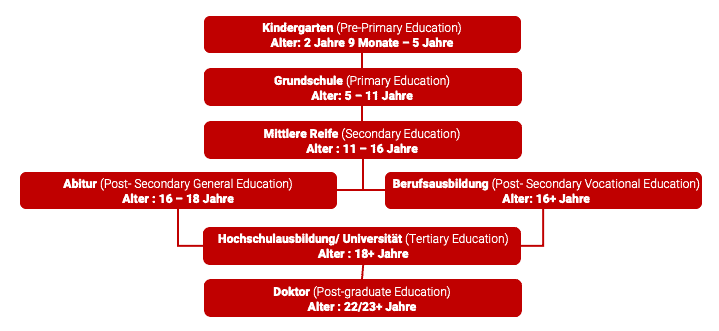
Source: Own illustration, based on Eacea.ec.europa
Conclusion
Malta is a very safe country for children. Due to the fact that many expats live in Malta, experience shows that both parents and children find it easy to make connections. The fact that children grow up bilingually (English is an official language) is a huge plus. While state kindergartens and schools differ from what you might know, you always have the option to choose a private institution that meets or exceeds the educational standards you are looking for.
If you have further questions about the Maltese school system or general questions about relocating, please don't hesitate to reach out via the contact form.
Disclaimer: The content of this article is for general information purposes only and does not constitute tax, legal or financial advice. Despite careful research, we make no guarantee for the accuracy, completeness and timeliness of the information provided. Tax regulations are subject to constant change. For individual advice, please consult a qualified tax advisor. Use of the content is at your own risk.
Stay Informed
Receive our latest articles on international tax planning, relocation and company formation directly in your inbox.
No spam. Unsubscribe anytime.
