Virtual Office in Malta – Tax Solution or Substance Trap?
Last updated: 10 February 2026

I'm over 40 now. To be precise, I'm almost 44. I have spent the vast majority of those 44 years sitting at desks and in office chairs. For my entire professional life, I've been what you'd colloquially call an "office worker."
The offices I worked in were mostly the classic kind. I started my career in Germany and Switzerland, where offices for small and medium-sized enterprises (SMEs) usually followed a standard pattern: a reception area, a hallway, and then doors to the left and right. You had specific areas for administration, accounting, the boss's office, conference rooms, toilets, and, of course, the kitchenette.
Questions of the Present
I wonder what things looked like in Malta back then? Did the same tax advantages exist? After all, these advantages are the main reason I'm discussing Virtual Offices in this article at all. What does it actually take to set up a company in Malta today? What options are available on the island, and—crucially—are they legally compliant from a tax perspective?
Malta Formation – Commercial Sense vs. Tax Compliance
If you are setting up a Malta Limited, you almost certainly have tax motives. That's understandable. Anyone incorporating here is looking to benefit from the effective 5% tax rate. That sounds tempting for any entrepreneur, but incorporation alone isn't the finish line. As a business owner, you need to think about how you want to develop your business in Malta commercially. What kind of operation do you want to build? Or rather, what kind of operation must you build?
There are operational reasons for this, but also strict tax law reasons. I'll get to that in a moment.
The History of the Virtual Office – My First Encounter
When I was in my early twenties—over 20 years ago now—my view of offices changed drastically. The location was Zurich Oerlikon, at the City Port. At the time, it was one of the most modern and advanced office complexes in the world. I was working for a company you'll know, an auditing firm with three letters, one of the "Big Four": PwC (PricewaterhouseCoopers).
At the City Port, I was introduced to quiet rooms, Kagami conference rooms, and even fully equipped sleeping quarters—just in case things ran late. That was all very fancy, but what I found truly groundbreaking was the underlying concept:
Using Only 50% Capacity
PwC had determined that their consultants, regardless of their specific field, spent on average 50% of their time outside the City Port, working directly at client sites. So, what did PwC do? They reduced the number of workstations/desks by 50% compared to the total headcount.
That was clever, and frankly, radical. Let's say there were 2,000 employees. In a "normal" office, the boss would have had to provide 2,000 desks. Assuming a desk costs 500 EUR per month, that's a total cost of 1,000,000 EUR monthly. If half the staff is away, 500,000 EUR is simply wasted on empty chairs.
This is where the concepts of "Hot Desking" and the "Clean Desk Policy" were born.
But they didn't stop there. Conventional thinking would suggest two employees share one desk. But how would that work? Do you draw a line down the middle like in primary school, with each side displaying their own family photos?
No Family Photos, No Post-its
At PwC, no employee had a fixed workstation. Exactly—NO ONE. Not a single employee was assigned a permanent desk. When you arrived at the office, you simply chose a free desk. You could use it for the day, but by evening, it had to be completely cleared and cleaned. For employees who needed physical files or binders, black plastic cases were provided. These were stored in a central locker within the building and could be collected the next day.
That was over 20 years ago, when the commercial internet was still in its infancy. Today, you wouldn't even need the plastic cases, as almost all files and folders are digital.
Malta – Everything Happens Digitally
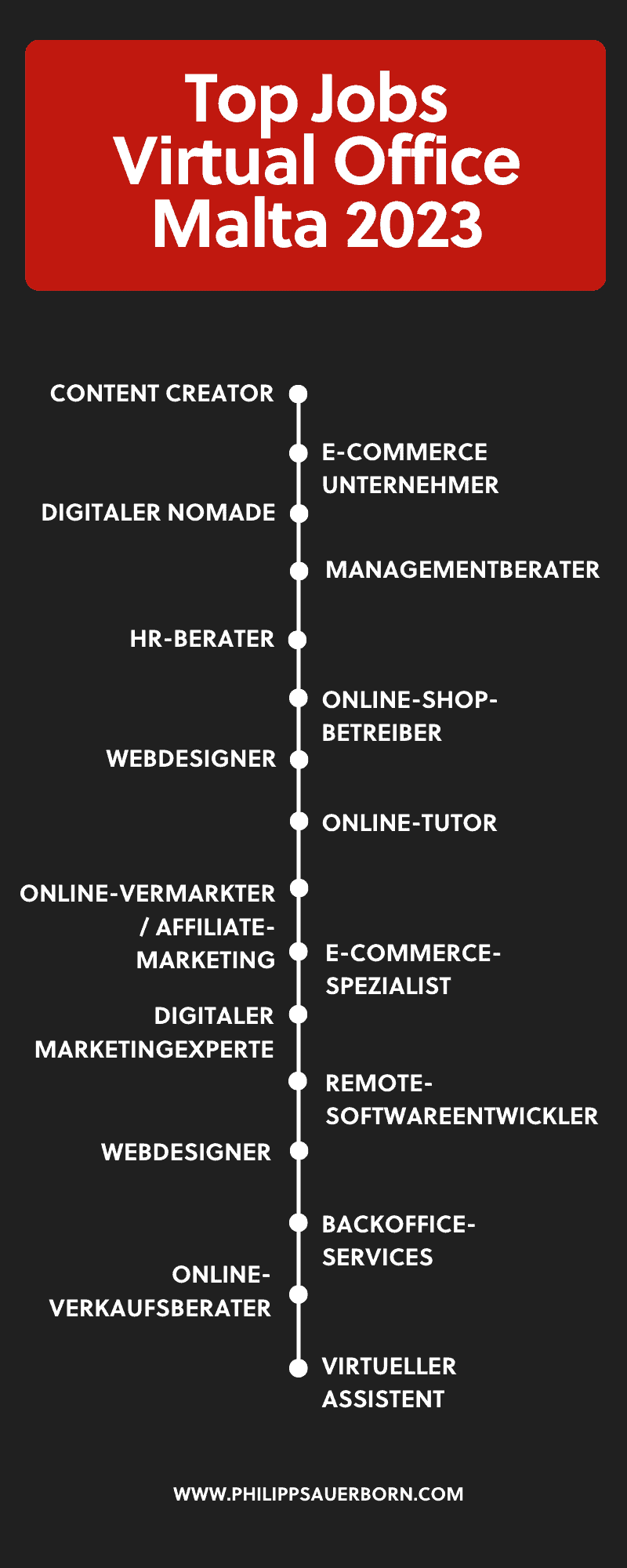
In a way, we can compare modern Malta to that PwC office in Zurich. Of course, Malta is a "bit" bigger, but the "employees" on Malta are also largely not permanently on-site. These "employees" are entrepreneurs who are active either in Malta or via Malta, for example through a Malta Limited. This includes business owners who live here, and those who don't. And they all do their work online, digitally, or via the cloud.
Here are just a few examples:
- Content Creators
- E-Commerce Entrepreneurs
- Digital Nomads
- HR Consultants
- Online Shop Operators
- Web Designers
- Online Tutors
- Virtual Assistants
- E-Commerce Specialists
- Digital Marketing Experts
- Remote Software Developers
- Affiliate Marketers
- Online Sales Consultants
- Management Consultants
- Backoffice Services
This list is almost stereotypical by now, as nearly any job can be done online these days. But specifically, those who come to Malta are usually offering something digital. Consequently, they think very carefully about whether they should operate a physical office with monthly rent, or look for a more suitable solution. They want a modern and, above all, cost-effective way of working when they are actually on the island.
The Real Estate Market in Malta
Malta is an island, which means one thing above all else: space is limited. And whenever availability is limited, prices generally only go one way—up. This is nowhere more apparent than in the real estate sector. I saw this phenomenon during my six years in London; the UK is also an island (albeit slightly larger than Malta), and prices there climbed incessantly.
Classic vs. Virtual Office vs. Hot Desking – The Property Bubble
You are completely exposed to this risk if you use, rent, or operate a "classic" office. Of course, you can't entirely avoid market forces with a Virtual Office, Hub Office, or Hot Desking setup. But the costs are much more manageable if you're paying a small monthly service fee rather than locking yourself into a 5-year commercial lease.
But that's not all.
In Malta, commercial leases are generally quite unfavourable for the tenant. First, you have to pay a high deposit, often 3-6 months' rent. Second, these contracts often have a duration of 5 years or more, and exiting early is difficult. Furthermore, top offices are often handed over in "shell form"—meaning you rent four concrete walls and have to install the partition walls, flooring, and utilities at your own expense. Conversely, most other "normal" offices look old-fashioned and a bit run-down.
Providers like Regus or Soho are miles ahead when it comes to modern standards.
COVID – A Massive Factor
The COVID pandemic had a colossal impact on the commercial real estate sector. Suddenly, entrepreneurs were forced to let large parts of their workforce work entirely virtually. And it worked. This triggered a revolution.
We all remember how strange it felt at first to hold meetings via video call. Zoom, Skype, Slack, and WhatsApp—tools previously used only by pure internet companies or for private chats—became mainstream business tools. The boundaries shifted even further toward the purely virtual office. Because what worked normally during COVID works just as efficiently without a pandemic. The commercial implications of this are immense.
What did we learn?
Suddenly, it became clear that thanks to the internet, many jobs are actually digital jobs that can be done from home. Whether you want to do that is another question.
COVID was a monumental push for the decentralisation of physical workplaces. And consequently, a monumental push for flexible work locations and Virtual Offices. This applies equally to Hot Desking, Hub Desking, and Virtual Offices in Malta.
Tax Law and the Virtual Office in Malta
International tax law, to be precise, has a problem with the idea of Hot Desks, Hub Working, and purely virtual offices. You can't really blame the legislators; the "old" (and still valid) international tax laws were written almost exclusively for companies that operated physically. This was an era long before the internet.
Today, and especially in the future, there will be more and more internet companies and fewer companies that need a physical nexus at all. Even companies that operated traditionally before COVID-19 have learned that physical presence isn't as critical as they thought.
So, where is the problem?
Tax law—or rather, the tax office—has the following issue:
It is legally difficult to tax a company if there is no physical presence, or if the presence doesn't fit the classic, historical legal definitions. It can feel as though the tax office is trying to force you into an outdated mould—a time when every entrepreneur had their own fixed address and their own physical office. Is the tax office trying to slow down the natural "digital," "decentralised" course of things?
Yes and no.
I would say that tax law is trying to catch up with the full range of possibilities. Providers of Hot Desking, Hub Working, and even purely virtual offices aren't doing anything wrong commercially, nor are they necessarily wrong from a tax perspective. But the entrepreneur might have a problem.
In tax law, it's all about value creation, and that is the dilemma.
The problem of lacking physical presence (or having a "lean" presence like a Virtual Office) gets complicated by the question of value creation. The tax authorities don't completely ignore these "new" offices, but the (internet) entrepreneur needs to have answers.
You need answers to the following:
Where does the value creation take place? Imagine a scenario where there are no Virtual Office providers, no co-working, no Regus. You run a Malta Limited and want to do everything right, so you rent a real office, appoint a local director, and employ two full-time support staff. Does value creation really happen there? Is something of value being "produced"? Or does this office exist solely to satisfy the tax office?
The principle of value creation questions exactly this. And if nothing is being created in a physical setup like the one described above, then even less is being created in a virtual office.
Therefore, I advise caution with solutions where nothing real happens on the ground.
Good News
For genuine digital nomads, this problem plays a minor role. The same applies to setups where the person "creating the value" does not live in a high-tax country that asks these difficult questions (like Germany or the UK).
No one knows exactly where this journey will end. I have been preaching for years that anyone who wants peace of mind and security should ideally relocate their residence—for example, to Malta. Once you are here, you can use any kind of Virtual Office, Co-Working, or Hot Desking solution and enjoy all the tax advantages without looking over your shoulder. Malta now has many providers offering exactly these kinds of flexible office solutions for digital nomads or relocators.
Conclusion
The bottom line remains: The rise of virtual or lean office setups is clearly visible in Malta. There are modern and efficient providers for relocators and digital nomads. However, in the context of international tax law, Virtual Offices do not carry the same weight as classic, exclusive office space. That said, it is crucial to note that both setups are vulnerable under tax law if no actual value creation takes place within them.
If you are living in a high-tax jurisdiction and using a Malta structure, substance is key. If you are living in Malta, the type of office matters less.
Disclaimer: The content of this article is for general information purposes only and does not constitute tax, legal or financial advice. Despite careful research, we make no guarantee for the accuracy, completeness and timeliness of the information provided. Tax regulations are subject to constant change. For individual advice, please consult a qualified tax advisor. Use of the content is at your own risk.
Stay Informed
Receive our latest articles on international tax planning, relocation and company formation directly in your inbox.
No spam. Unsubscribe anytime.
