Digital Nomad – Why You Need a Tax Residence
Last updated: 10 February 2026

Who doesn't dream of it? Sitting on the beach, opening the MacBook, typing a few lines while gazing dreamily at the sunset or sunrise, followed by a Caipirinha or a Soy Macchiato (depending on the time of day). Then a quick swim, a bit more typing, and eventually sitting around a bonfire with your boyfriend, girlfriend, or mates, smoking shisha. All of this in Bali, of course. And with the appropriate hairstyle. Not too wild, though, because you've still got that video call later with the client from Germany, and they tend to be a bit conservative.
The Digital Nomad Cliché – Did I miss anything?
Probably some Instagram post about work-life balance.
After a few weeks, you head off to Vietnam or India, and maybe the USA after that. Eventually, that client from the video call gets in touch via email.
"Dear [Name], thanks for your great work. However, could you please send us a proper invoice? Our tax advisor is no longer accepting invoices from random hotels around the world. We need a tax number and a proper billing address from you. That shouldn't be a problem, right? Best regards, Your Client."
Invoicing as a Digital Nomad: It shouldn't be a problem. But it is.
Because you don't have a tax number. You don't have a fixed address. And actually, you don't want either. Because what are you?
A Digital Nomad.
Suddenly, you're faced with a problem that many of your digital colleagues have—or will have. Because no matter what you've read on blogs about how great and legal it is to be resident nowhere, your client doesn't care. More importantly, your client's tax advisor doesn't care. And most importantly: Your client's tax office (Finanzamt) cares the least.
Tax-Free Digital Nomad: It's not about legal or illegal.
It's about compliance effort. It's about the time people have to waste on you because you don't fit the standard pattern from a tax perspective. If your client constantly has to explain your situation to their tax advisor or the tax authorities just because you decided to work from a beach in Bali, Vietnam, or the USA, what risk does that create?
Exactly.
Eventually, the client tells you:
"Great work, but it's just too much hassle for me."
And the more money you earn, and the more clients you have, the higher the risk of ending up in this scenario.
So, is that the end of the Digital Nomad dream?
No.
I can explain this using a completely different example. Funnily enough, with an example from Malta—one of the very countries that can help you with the problem described above. But I'll get to that later.
Digital Nomad Status is legal but doesn't work: An analogue comparison with the Malta ID Card.
In Malta, residents receive a residence card, the Malta ID Card. It's essentially the Maltese identity card and looks exactly like all EU National ID Cards do these days.
Malta ID Card: A fancy plastic card in credit card format.
Hologram, EU logo, photo, ID number, address – it's all there. Just like on a German ID card.
The EU states here: https://europa.eu/youreurope/citizens/travel/entry-exit/eu-citizen/index_en.htm
"As an EU national, you have the right to travel freely in the 27 EU member countries as well as in Iceland, Liechtenstein, Norway and Switzerland (non-EU countries but members of the Schengen area) carrying either a valid passport or a national identity card (ID)"
Note that it doesn't say passport AND ID card, but OR.
So, you can travel legally with it. Do you think an airline cares?
The answer is no.
With the Malta ID (residence card for non-Maltese), you won't get far because private operators often don't accept it as a travel document. You can stand at the airport arguing that it's all legal until you're blue in the face.
Nobody cares.
The airline doesn't, and neither does your client.
Malta ID and the legal status of the Digital Nomad:
You have a very similar situation here: There is something that is officially and legally derivable from the law. But it isn't accepted on the "free market."
But since we're already talking about Malta, let's stick with it, because the island offers a solution to your problem.
And that is:
HABITUAL RESIDENCE: A Strategy for Digital Nomads
Never heard of it? Then you'd better read on. The concept of the digital nomad is outdated from a tax law perspective.
Tax-wise, it might be legal, but it's still a loophole. And as with any loophole: It's not intended. But closing this loophole legally is difficult. Even though it's an unwritten rule of international tax law that no person anywhere in the world can, may, or should pay zero taxes.
However:
Since it's legally difficult to restrict your mobility, authorities came up with another clever idea.
To make it difficult via compliance. Specifically, tax compliance. And that brings us right back to the example of your client on the video call.
And the compliance crackdown isn't even aimed at you. It's aimed at your client. They shouldn't have an easy time if they work with someone who "doesn't play by the rules." Being compliant means following the rules. I'd like to give you a practical example of how the compliance screw has been tightened for those who step out of line.
Banks: A Compliance Nightmare for Digital Nomads?
When tax investigators got tired of digging through numbered accounts, offshore statements, and weird invoices, they passed the responsibility on to the banks. The motto was: "Banks, just give us the data of anyone who opens an account."
And bam:
Suddenly, banks had to be "tax compliant," and anyone who wanted to open an account had to be too. Banks don't really care how legal a tax loophole is. To avoid trouble—even just the trouble of an audit—everyone now needs to have a tax number.
And it went further:
The tax number would have been bearable, as would exchanging account data with tax authorities. But the authorities kept turning the compliance screw.
Money Laundering: Let's just count tax evasion as part of that.
And with that, further responsibility and compliance requirements were handed over to the banks. That's when we started seeing those annoying "Source of Funds" and "Source of Wealth" questions.
So, what can you do?
Let's get back to Habitual Residence. This is a term from international tax law found in all Double Tax Treaties (DTT). Including the DTTs with Malta.
Why Malta is the answer for Digital Nomads:
That is exactly where I recommend you become "habitually resident." Yes, it's a small restriction on your existence as a digital nomad, or call it a rule. It's even better if I put it this way:
I recommend a habit.
That's exactly what a "habit" is. And the habit is that you come to Malta regularly, year in and year out, for a few weeks or a few months a year, stay here, and always return. For this to work, you need your own apartment in Malta. And you also need the typical setup: ID card, social security number, proof of employment, health insurance, tax number.
But most importantly: Forming a company in Malta.
I'll come back to setting up a Malta Limited later. Let's look at Malta's tax law, international tax law, the DTT, and why this "habit" is so important.
You have to picture it like this:
You should be officially resident in Malta so that you can tell banks or your clients with a clear conscience that you live in Malta. You have the setup mentioned above as proof/backup. But more importantly, to explain to a country that you live in Malta, you need to show a bit more. According to the DTT, you must reside in Malta and, above all, exclusively in Malta.
This means:
You must satisfy the residence criteria "domestically" (Malta tax law) and "internationally" (DTT). Also important: Of course, you must not have anything in any other country that would trigger a residence there: staying more than 90 days, an apartment, a spouse and children, etc.
The 90-day rule comes from German tax law. Anyone who spends more than 90 days in Germany as a representative or authorized signatory of a foreign company triggers a Permanent Establishment (PE) there. But similar rules exist in other countries, so it's best to use these 90 days as a rule of thumb.
So let's look at Malta tax law, the Malta Income Tax Act:
https://legislation.mt/eli/cap/123/eng/pdf
It speaks of "resident" and "ordinarily resident" but doesn't fully define what that really means. However, there is an interpretation of "resident" from the tax authorities in Malta, found here: https://cfr.gov.mt/en/individuals/Pages/Tax-Residence.aspx.
And here we find the crucial clue. Actually, there are two clues.
"…an individual who does come to Malta to establish his residence becomes resident from the date of their arrival…" The intention is sufficient.
Anyone who comes to Malta to become resident is resident from arrival.
And further:
"It can also apply to individuals who do not stay in Malta for more than 183 days in any year but who come to Malta regularly over a long period – say, over a period of three years – and establish personal and economic ties with Malta."
And that is exactly what I wrote above. Let me break it down for you:
"It can also apply to individuals (that's you) who do not stay in Malta for more than 183 days in any year (a few weeks and months) but who come to Malta regularly (over a long period… year in, year out… regularly to Malta) – say, over a period of three years – and establish personal (Apartment, ID Card, Social Security Number, Proof of Employment, Health Insurance, Tax Number etc.) and economic (Company in Malta) ties with Malta."
Digital Nomad: This describes Habitual Residence.
Wikipedia defines Habitual Residence as follows: https://en.wikipedia.org/wiki/Habitual_residence
"…There is normally only one habitual residence where the individual usually resides and routinely returns to after visiting other places. It is the geographical place considered 'home' for a reasonably significant period of time".
Thank you, Wikipedia.
Let's look at that again with my comments: "There is normally only one habitual residence (only ONE is possible, meaning if this is the case, then it IS and CAN only be Malta), where the individual (that's you) usually resides (…year in, year out… regularly to Malta) and routinely returns (always coming back) to after visiting other places… (wherever you happen to be as a digital nomad).
This makes you resident in Malta as a Digital Nomad.
And with that, you also have the "protection" of the DTT. Because: If you are not considered resident in Malta, the DTT does not apply. Many make the mistake of trying to use the DTT even though they aren't actually considered resident in the country.
Let's look at exactly this DTT protection.
Here is what it says regarding "Resident":
…an individual is a resident of both Contracting States, then his status shall be determined as follows:
- b) if the State in which he has his centre of vital interests cannot be determined, or if he has not a permanent home available to him in either State, he shall be deemed to be a resident of the State in which he has an habitual abode;
When two argue… …Malta rejoices.
The case mentioned above only arises if another country assumes for some reason that you are resident there.
But wait!
Didn't we write at the beginning that it's not about legal or illegal? Exactly! Therefore, in most cases that have nothing to do with any tax office yet, you will only need the "Malta Habitual Residence" described above. Because with that, you will answer all compliance questions.
You can follow all the rules.
But much more importantly:
Properly employed and advised, the concept above helps even further. Namely with a problem you might not even have on your radar yet. It is, surprise surprise, another compliance problem.
Which one?
Source of Funds and Source of Wealth checks.
Digital Nomad without Habitual Residence Malta:
A huge problem, because how is your bank supposed to know that you aren't evading taxes if you don't have a single document that makes you look "normal" and "compliant"?
Questions like:
- Where does the money come from?
- What kind of invoice was issued?
- Where do you pay tax?
- Where does your company pay tax?
- Where is your business registered?
- I need proof of income!
Digital Nomad with Habitual Residence Malta: Piece of Cake.
"Dear Bank, here is:
- My tax number
- My Residence Card
- My rental agreement
- My tax return
- My social security number
- My payslip
- My VAT return
- The tax number of my Ltd, incorporated where I live
- The financial statements of my company
- The tax return of my company
Any questions?"
You can provide information exactly as the bank expects and understands it.
YOU ARE COMPLIANT!
And your client from the video call? They get a proper invoice from now on.
Conclusion and Summary:
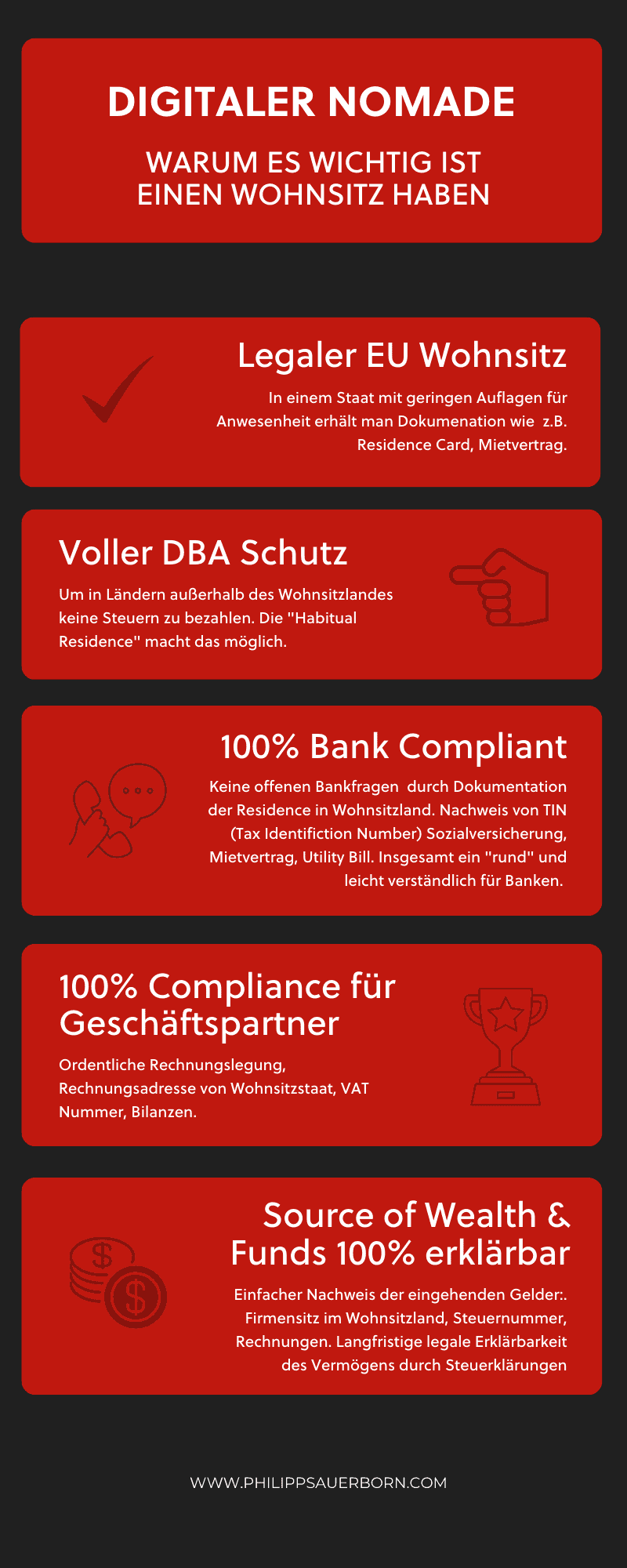
Habitual Residence in Malta for Digital Nomads. 4 huge advantages for just a few weeks of stay in Malta per year:
- Legal residence in an EU state
- Full protection of Double Tax Treaties (DTTs)
- 100% compliant for any inquiries from banks, clients, or authorities
- 100% proof for Source of Funds and Source of Wealth checks
Disclaimer: The content of this article is for general information purposes only and does not constitute tax, legal or financial advice. Despite careful research, we make no guarantee for the accuracy, completeness and timeliness of the information provided. Tax regulations are subject to constant change. For individual advice, please consult a qualified tax advisor. Use of the content is at your own risk.
Stay Informed
Receive our latest articles on international tax planning, relocation and company formation directly in your inbox.
No spam. Unsubscribe anytime.
