Ultimate Guide to Private Yacht Registration in Malta 2026
Last updated: 10 February 2026

You know the old joke.
What are the two happiest days in a boat owner's life?
The answer: The day they buy the boat and the day they sell it. Whether that’s actually true is something the lucky individuals who have bought a yacht will have to confirm for themselves.
But here is what is definitely true:
For all the days between buying and selling, the yacht needs to be registered. And to ensure those days remain happy—at least from a registration perspective—you are now reading the ultimate guide that will illustrate everything you need to know about Yacht Registration in Malta.
This article covers the most distinct aspects of registration but also dives into the crucial tax matters. You'll find information on tax possibilities and potential savings, and—in a nutshell—how you can achieve both. This includes VAT.
Malta – Introduction and History
Malta: small but mighty. Geographically, that might be true. But for the Maltese shipping register, the statement should really be:
Malta Ship Registry: massive and mighty!
In fact, this register is one of the largest in the world. In terms of the number of existing registrations and new entries, it is world-class. The Ship Registry falls under "Transport Malta," the Maltese Authority for Transport. This authority doesn't just regulate and supervise yachting in Malta. If you ever get a parking ticket here, it’s likely from a nice gentleman or lady employed and authorised by Transport Malta. But in the shipping segment, Transport Malta looks after not just yachts, but also the "heavyweights"—tankers, cruise liners, and container ships.
A Good Reputation Always Means: Lots of Paperwork
The authority takes care of everything that moves on the water, making the Malta Ship Registry holistic and able to boast a solid reputation.
And that reputation is exactly why registering a yacht in Malta is as regulated as it is. On the websites of Transport Malta, as well as those of shipping agents or law firms, I often read—with a bit of a smirk—phrases like: "Yacht registration whether private or commercial is a very simple and straightforward process subject that all documentation is in order."
Basically: "It's no problem, it's all simple, PROVIDED THE FORMALITIES ARE PERFECT."
That’s a bit like someone telling me that losing weight is quick and easy, PROVIDED I JUST EAT LESS. But that is exactly why I don't find it simple or quick, and that’s precisely where the rub lies.
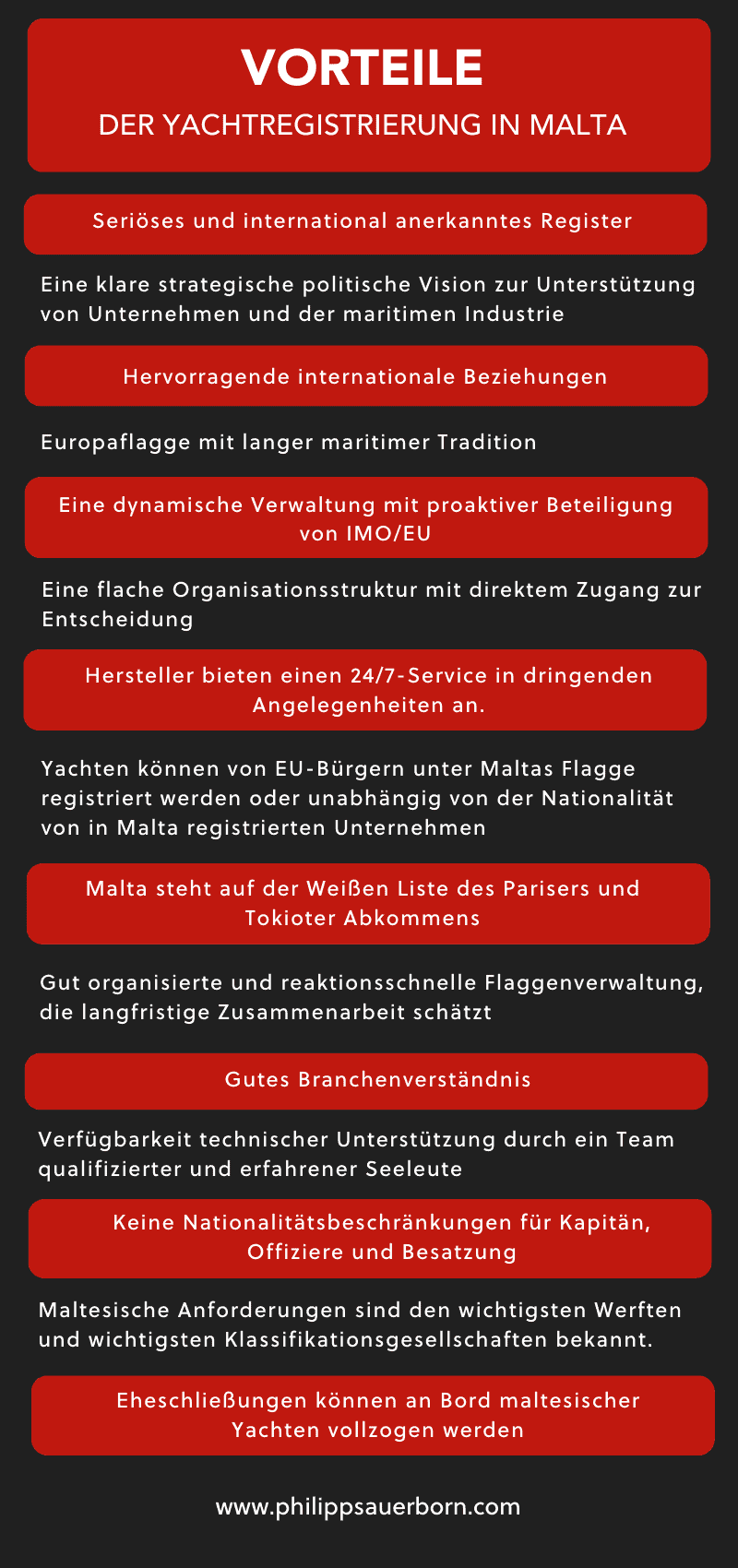
This article offers a 360-degree view of yacht registration in Malta, including the technical and formal details. But let's first address the question of why you would want, should, or can register your yacht in Malta. Let's look at the benefits first:
Advantages of the Malta Flag for Yachts
- Reputable and internationally recognised register
- A clear strategic political vision supporting businesses and the maritime industry
- Excellent international relations
- European flag with a long maritime tradition
- A dynamic administration with proactive participation in IMO/EU
- A flat organisational structure with direct access to decision-makers
- Manufacturers offer 24/7 service for urgent matters
- Yachts can be registered under the Malta flag by EU citizens or by Malta-registered companies regardless of nationality
- Malta is on the White List of the Paris MoU and Tokyo MoU
- Well-organised and responsive flag administration that values long-term cooperation
- Good understanding of the industry
- Availability of technical support from a team of qualified and experienced mariners
- No nationality restrictions for the captain, officers, and crew
- Maltese requirements are well known to major shipyards and classification societies
- Marriages can be officiated on board Maltese yachts
Maritime History
The current version of the Ship Registry was born in 1973, back then as the "Malta Flag Registry," also known as the "Malta Shipping Directorate." Malta is, as is well known, an island strategically located between Europe and Africa (North to South) and between the Atlantic and the Suez Canal (West to East).
Consequently, kings, emperors, generals, dictators, naval powers, armies, and countries have always fought for dominance here. Especially maritime dominance. Among the earliest organised besiegers were the Phoenicians and eventually the Romans. They were followed by the Byzantines and the Arabs/Persians. In 1530, it was the "Knights Templar" or the "Knights of St John" who established their power and maritime presence so dominantly that Malta is still shaped by it today. You can still admire the fortifications of the capital, Valletta, and the "Grand Harbour" surrounding it, which remain almost unchanged from the days of the Knights.
And speaking of naval power, there comes the inevitable moment when the good old British arrive, conquer everything, and keep it. That happened in Malta in 1800, and Malta only broke away from that in 1964 with its declaration of independence.
Much like the Templars, the British left their unmistakable mark: the language, the steering wheel and driving on the wrong side of the road, police without guns, and, of course, a great affinity for the sea.
I’ve essentially spoiled the ending already, but the Nazis never took Malta—and God knows they tried. With Stukas, U-boats, warships, and Junkers 52-3m. None of it worked; Malta defended itself and the seas around it fiercely.
Nowadays, Malta is no longer as militarily significant as a central Mediterranean location. But the Grand Harbour in the south of the island is a vital stopover for major shipping lines. And superyachts and cruise ships use the depth of the Grand Harbour to anchor right on Malta's urbanised coast.
Types of Yacht Registration in Malta – Overview
This guide is strictly about registering "Pleasure Boats." Transport Malta refers to these as "Superyachts."
Essentially, these are "normal" yachts you might buy "off the shelf." I know, no yacht is ever truly "off the shelf"—there's always a huge degree of customisation involved. My point is to distinguish them from ships not bought or used for private purposes (like the tankers and cruise liners mentioned above). Simply put, a yacht must not be too small, but also not too big, to be registered as a Yacht / Superyacht in Malta.
Let's look at the two types of registration:
Private Yacht Registration Malta
The name "Private Registration" says it all. This is about pure private enjoyment. You are affording yourself this luxury strictly for yourself, and only you use the yacht privately, without lending or chartering it out. From a tax perspective, the most important element is VAT (Value Added Tax). You have to pay this, just as you do on all goods or services used and enjoyed privately. If you buy a used yacht, you will often find the note "VAT PAID" or "VAT UNPAID." "VAT UNPAID" usually implies that the yacht you intend to buy was previously used commercially.
Your yacht must be at least 6 metres long to qualify for "private superyacht registration" in Malta. This applies equally to sailing or motor yachts.
Commercial Yacht Registration Malta
Perhaps you've chartered a yacht for a day or a week during a summer holiday. Probably at a healthy daily or weekly rate. For you, it was pure private pleasure, but for the owner of the yacht or the crew (e.g., the captain), it was work or a commercial activity. A service you paid for.
On your invoice for the trip, VAT was charged.
A commercial registration means you are pursuing commercial intentions by chartering out the yacht. On one hand, you want to earn money, and you must pay tax on potential profits. But on the other hand, you can naturally claim costs, just like any other business. This applies to VAT as well. You charge/collect VAT, but you can offset this against VAT you have paid. This also applies to the acquisition costs and any VAT you paid when purchasing the yacht. Ultimately, for you as a commercial operator, VAT is a pass-through item, just as it is for any other business. The VAT exists only as a cash flow element. Therefore, such a yacht would be resold as VAT UNPAID.
Think and act consistently commercially!
That doesn't read too badly at first glance, you might think. But the devil is in the details. In fact, the yacht must actually be chartered out for you to be considered "commercial" at all. And even if you, as the owner, want to enjoy the sea with your "own" boat for a weekend, you must charge yourself the charter fee plus VAT and pay it, just as if you were a "normal" guest.
And it requires "normal" accounting, including depreciation of the yacht.
EU VAT on a Commercial Yacht in Malta
For me, the biggest disadvantage—or rather the most complex part—of a commercial registration is VAT across different EU countries. You must charge VAT where the charter guests board the vessel. Even if you are the charter guest yourself. This can mean you need a VAT registration in every single EU country you operate in, and you must comply with all VAT regulations in that specific country. Consequently, note that there are both income tax and VAT aspects to comply with!
You can also hire a shipping or charter agent per EU country, and they usually handle the VAT etc. for you. But that, of course, costs money again.
The topic of EU VAT plays no role if you are chartering commercially outside the EU, for example, in the Caribbean.
Malta Yacht VAT Leasing
If you speak to a yacht registration specialist in Malta, they might tell you about the "old" VAT leasing scheme with a tear in their eye.
This was a finance lease structure that was incredibly successful because it allowed for a significant amount of legal VAT savings. It was probably too successful and saved too much VAT. Unfortunately, this instrument was scrapped in 2018 under pressure from the EU and replaced by a new leasing scheme, which corresponds more to a "classic" operating lease. It is precisely this "new" VAT leasing that I want to introduce below.
Attention, this gets complicated.
VAT leasing is a hybrid. An attempt to bring commercial and private registration under one roof.
In the Maltese version of VAT leasing, the basic assumption is that only one person will use the yacht: the owner. To be precise, the Ultimate Beneficial Owner (UBO) or the owner of the owning company. This company is a Malta Limited and is opened as a normal business with VAT registration.
However, the company is not a charter company, but a yacht leasing company. This allows the yacht to undergo Private Registration as a pleasure yacht, because only the owner will use the ship. All costs can still be claimed, including VAT, for example on the purchase.
The lease agreement must be concluded and commence in Malta to fall under Maltese VAT rules. This means the yacht must be physically in Malta at the start of the lease. As must the lessee.
Now for the most important part: The lease agreement must be concluded for a duration of more than 90 days to be considered a LONG-TERM LEASE falling exclusively under Malta's VAT rules.
The leasing company now issues the lessee, for example, monthly invoices. Because it is a long-term lease, Malta's VAT rate is due on these invoices—currently 18%.
So far, you might be thinking there isn't really a benefit.
But here it comes:
I mentioned earlier that VAT can only be levied within the EU. Imagine you receive a monthly lease invoice of €10,000 net. Your own leasing company calculates 18% VAT on this, i.e., €1,800. This results in a gross amount of €11,800, which you must pay in full to your own leasing company.
However, if you now sail the yacht out of the EU—to be precise, if the yacht is not in EU waters—then you have somehow paid too much VAT, because VAT can only be levied in the EU.
I must explicitly mention here that this is about EU waters. As soon as the yacht is outside an EU 12-mile zone, even by just one metre, you are outside the "reach" of VAT rules and the calculation of "EU" VAT.
And this "outside" is exactly what matters.
After the first year, the leasing company (which belongs to you) can explain/inform the Malta VAT authorities that too much VAT was charged because the yacht spent, for example, only 3 days within EU waters. And in a month of 30 days, 3 days is just 10%. If you were in EU waters 10% of the time, that means 90% of the VAT was charged and paid in excess. The leasing company thus has a claim for a VAT refund.
Time spent outside the EU is proven via GPS data.
In the first year of the lease, the standard VAT rate of 18% is due on every invoice. For every subsequent year, the average value of the previous year is applied.
Let's stick to a simple example: the yacht spent exactly half of the first lease year outside EU waters. This means that in the second year, only half of the standard VAT rate needs to be levied—i.e., 9%—on every instalment. This game is repeated in every subsequent year.
Normal depreciation limits apply.
My personal opinion on Malta Leasing: It's complicated. In my view, it is only worth it for yachts with a purchase price north of €5 million. Below that, the cost-benefit ratio is too low for my liking.
Importing a Yacht to Malta
If a yacht is purchased from outside the EU, import tax must be paid upon entry into the EU. For an import to Malta, that's 18%. But is it really 18%? Or is there perhaps a way via Malta to ensure your cash flow doesn't have to suffer?
The answer is yes. For imports, Malta offers a complete neutralisation of import VAT.
Read on.
Importing to Malta is relatively simple, although the authorities must and will board the yacht in Malta to verify that the value of the yacht on paper corresponds to its real value. This applies to the total value including the yacht's equipment.
An example: The list price of a yacht is €500,000, but your yacht has exclusively gold fittings. That increases the real value, and import duty becomes due on that higher value.
Why import appears in this guide at all:
If you intend to register a yacht for commercial use in Malta and import it into the EU via Malta, the Malta Customs / VAT Department has a cash flow sweetener for you.
Let's imagine the yacht has a real value of €100,000. That would mean €18,000 import VAT payable upon entry into the EU via Malta. However, since you state that you will operate the yacht commercially, it is clear that you (or your commercial charter company) will eventually get this VAT refunded. You remember, I reported on exactly this earlier.
Therefore, the authorities offer a deferment of the import VAT that would actually be payable. This must, of course, be applied for and approved, but it can really pay off, especially if the yacht has a correspondingly high value.
In the charter company's first VAT return, this import VAT item is neutralised.
Yacht Registration Malta – Process, Formalities, and Costs
In this chapter, we get down to brass tacks. The bureaucracy. And there is a lot of it, because registering a yacht in Malta is simply not "quick and straightforward."
The official reason for this is reputation. To ensure everything is done "properly." But hand on heart, unofficially, it's pure self-preservation. You shouldn't, won't, and can't handle the registration alone; you have to appoint someone in Malta. An agency, a lawyer, or a firm like Dr. Werner & Partners. And we are happy to help you with it as "quickly and straightforwardly" as is realistically possible.
But let's get started:
Provisional Registration of a Yacht in Malta – Process
To get a "foot in the door" in Malta and have some sort of official status, you receive a kind of "pre-registration," known in English as "provisional registration."
Provisional registration must be converted into permanent registration after a maximum of 6 months. An extension of a further maximum of 6 months can be applied for, but this must be approved by the authority. From experience, I can say that the authorities do not like approving extensions. Therefore, I recommend getting started on the permanent registration as soon as possible after the provisional registration.
Provisional Registration of a Yacht in Malta – Required Documents
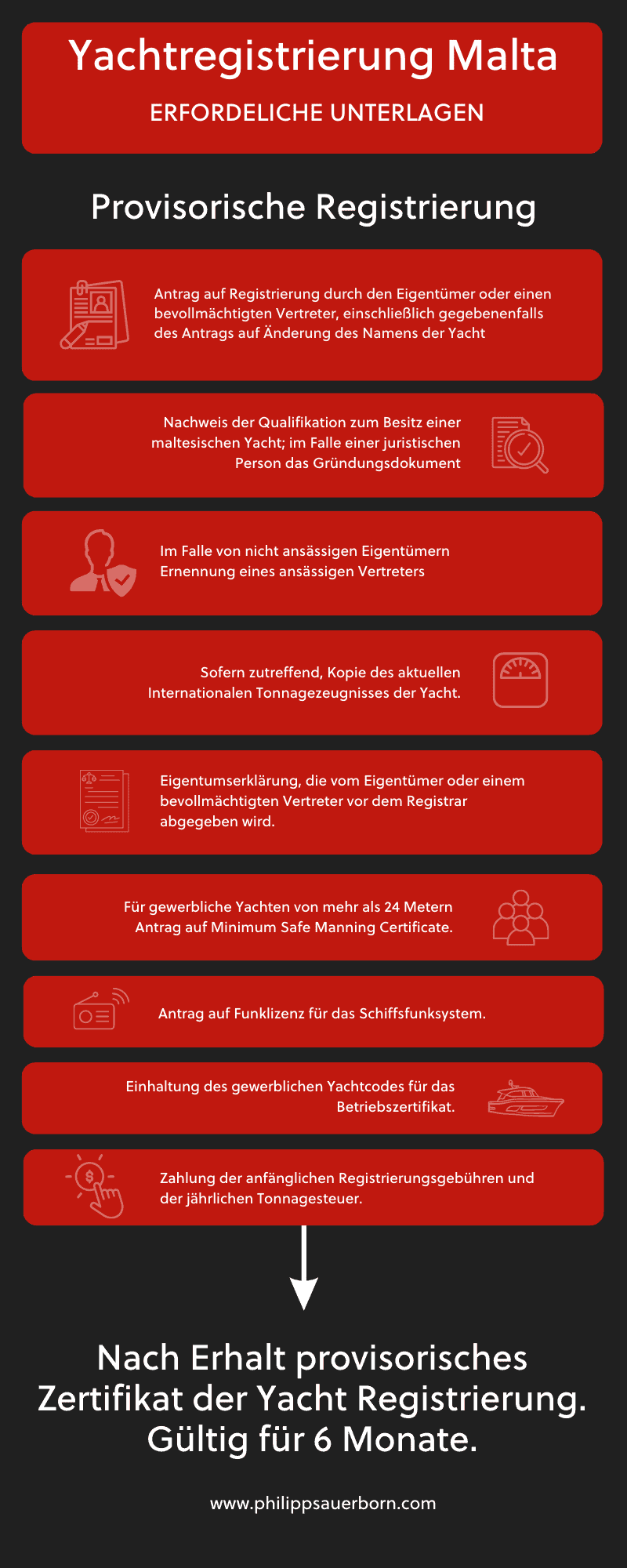
The following documents are required for the provisional registration of a yacht in Malta:
- Application for registration by the owner or an authorised representative, including, if applicable, the application for change of the yacht's name.
- Proof of qualification to own a Maltese yacht; in the case of a legal entity, the incorporation documents.
- In the case of non-resident owners, appointment of a resident agent.
- If applicable, copy of the yacht's current International Tonnage Certificate.
- Declaration of ownership made by the owner or an authorised representative before the Registrar.
- For commercial yachts over 24 metres, application for a Minimum Safe Manning Certificate.
- Application for a radio licence for the ship's radio system.
- Compliance with the Commercial Yacht Code for the Certificate of Compliance.
- Payment of initial registration fees and annual tonnage tax.
Permanent Yacht Registration Malta – Process
As soon as the documents listed below have been submitted to the authorities, the actual registration—the "permanent registration"—is applied for and certified by the authority.
A Malta registration certificate must be renewed on the anniversary of the Maltese registration.
The following documents are required to move from provisional to permanent registration:
Permanent Registration of a Yacht in Malta – Required Documents
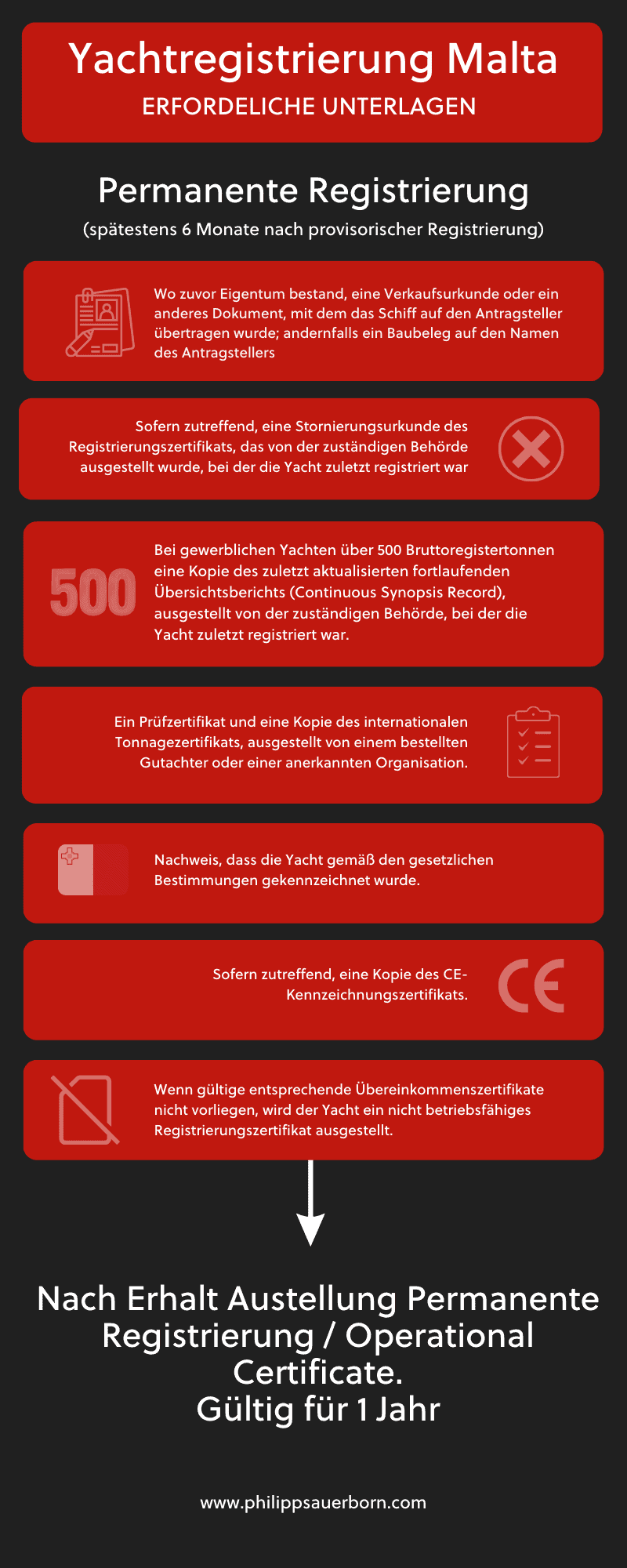
- Where ownership previously existed, a Bill of Sale or other document transferring the vessel to the applicant; otherwise, a Builder's Certificate in the applicant's name.
- If applicable, a deletion certificate of the registration certificate issued by the competent authority where the yacht was last registered.
- For commercial yachts over 500 gross tonnes, a copy of the last updated Continuous Synopsis Record issued by the competent authority where the yacht was last registered.
- A survey certificate and a copy of the International Tonnage Certificate issued by an appointed surveyor or a recognised organisation.
- Proof that the yacht has been marked in accordance with statutory regulations (Carving and Marking Note).
- If applicable, a copy of the CE marking certificate.
- If valid corresponding convention certificates are not available, a non-operational registration certificate will be issued to the yacht.
Official Fees for Yacht Registration Malta
| Annual Fee | ||
|---|---|---|
| Type of Vessel | Registration Fee | Basic Fee |
| i) Vessels with an overall length of less than 24 metres | ||
| b. Commercial Yacht | € 115 | € 150 |
| c) Pleasure Yacht with less than 50 gross tonnes | € 115 | € 25 |
| All other vessels with an overall length of less than 24 metres | ||
| d) less than 50 gross tonnes | € 115 | € 25 |
| e) greater than/equal to 50 gross tonnes | € 150 | |
| Vessels with an overall length of 24 metres or more: | ||
| (ii) Pleasure Yacht | 25 cents per net tonne, but at least € 187.50 | € 255 |
| (iii) Commercial Yacht not falling under category (iv) | Fees as listed in Section B | € 625 for the year of registration |
| thereafter € 1,095 | ||
| v) Merchant ships and fishing vessels with a gross tonnage of less than 2500 and not falling under categories ii, iii and iv | € 255 | |
| vi) All other vessels with an overall length of 24 metres or more not falling under categories ii, iii, iv or v | ||
| a. Vessel with less than 300 gross tonnes | Rates as in paragraph B subject to reduction according to paragraph C | € 370 for the year of registration |
| thereafter € 840 | ||
| b. Vessel with 300 gross tonnes or more | € 625 for the year of registration | |
| thereafter € 1,095 |
The table reflects it well. There are many diversifications and calculation methods. At first glance, the fees seem bearable. And they are. So why are consultants so expensive? Are you being taken for a ride here?
No.
If the goal is registering your yacht in Malta, then in this case, the journey is the destination. Because that is where the problems lie. That is where the stumbling blocks are. That is where the progress of the registration stops because the authority is missing something or something doesn't meet standards. But if you look at the fees above, you will be able to deduce that Transport Malta does not prepare the application for you. There, an incorrect application goes to the bottom of the pile or is rejected. And to ensure exactly that doesn't happen, it is sensible, necessary, and above all time-saving and ultimately efficient to engage a good advisor who will charge an appropriate fee for it.
Conclusion
Malta is a top address and an excellent choice for flagging a private yacht; the advantages outweigh the disadvantages, in my estimation. Especially since the disadvantages are really just the necessary evil to achieve the advantages.
Main Advantages and Main Disadvantages of Malta Yacht Registration
| Advantage | Disadvantage |
|---|---|
| High reputation worldwide | High bureaucracy |
| Authorities and service providers with experience and expertise | Costs involved in engaging service providers |
| Transparent and predictable prerequisites, rules, and costs | Rather slow bureaucracy |
| Peace of mind | |
| Compliance with international standards |
Disclaimer: The content of this article is for general information purposes only and does not constitute tax, legal or financial advice. Despite careful research, we make no guarantee for the accuracy, completeness and timeliness of the information provided. Tax regulations are subject to constant change. For individual advice, please consult a qualified tax advisor. Use of the content is at your own risk.
Stay Informed
Receive our latest articles on international tax planning, relocation and company formation directly in your inbox.
No spam. Unsubscribe anytime.
