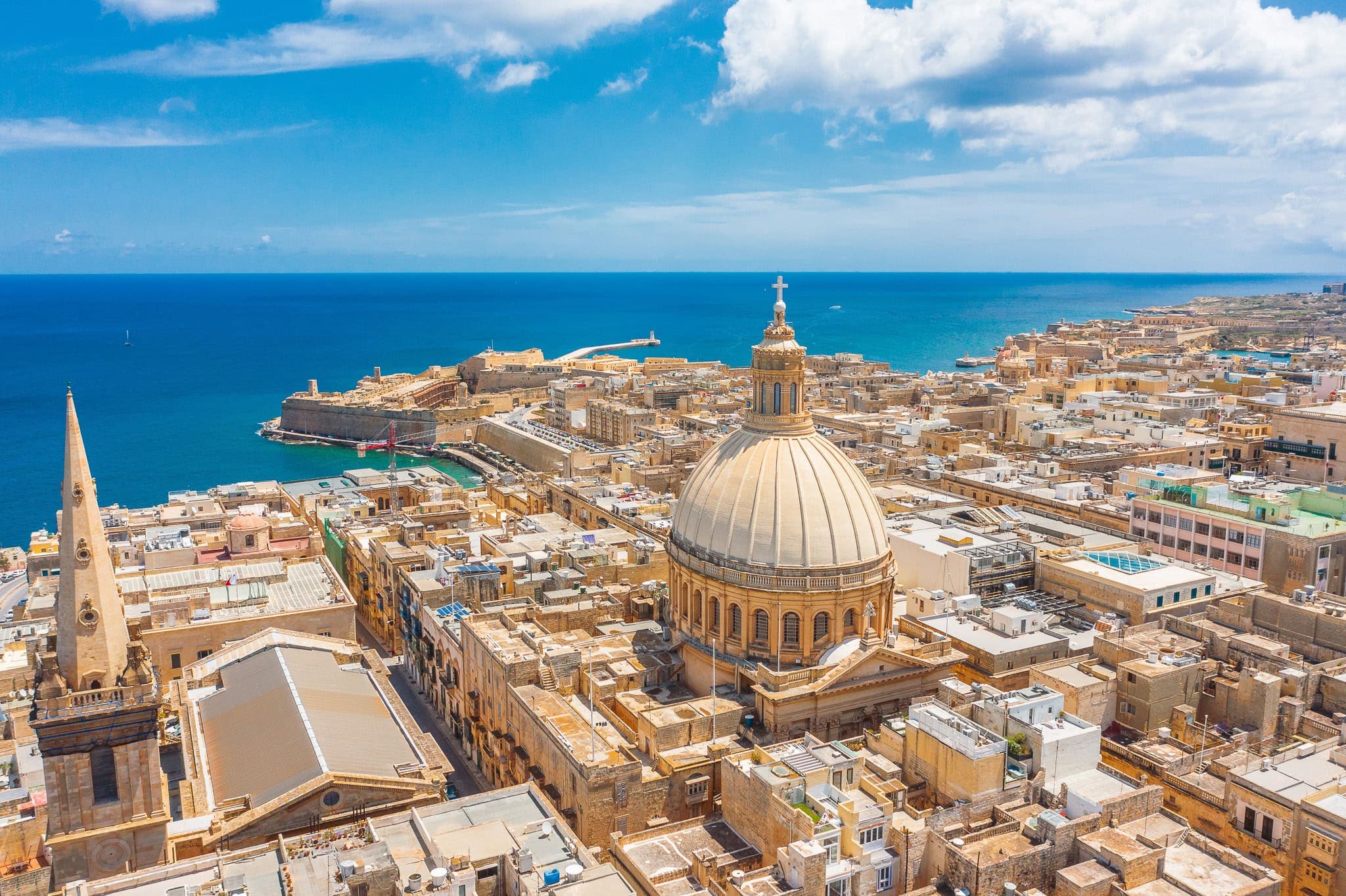
Malta

EU location with a refund system (tax refund to shareholders), effectively about 5% on active profits, and non-dom rules. Status 2026.

Not yet decided on a country? See the tax comparison of Malta, Dubai, Cyprus and Portugal

The trigger is often a company whose profits are taxed in Germany at about 30% (status 2026) in corporate tax, solidarity surcharge and trade tax. Malta has been an EU member since 2004 and has used the euro since 2008. The Maltese tax system works through a refund to shareholders. My assessment: the refund system is provided for by law, but it requires a clean structure with real substance.

At a Glance

Status 11/2026 · checked on 23/11/2026

Corporate tax
35%, effectively about 5%After a distribution, the state refunds 6/7 of the tax on active profits to the shareholder on application, and 5/7 for passive income (effectively about 10%). Status 2026. Sources [1], [2]
15% option
15% final, optionalSince 2025 a company can opt for a final tax of 15% instead of the refund system; the election is binding for five years and is made in the tax return. Sources [3], [4]
Non-dom rules
Remittance basisForeign income of residents without a Maltese domicile is taxed only to the extent it is brought into Malta; foreign capital gains remain exempt. Minimum tax of EUR 5,000 with foreign income of EUR 35,000 or more (status 2026). Sources [1], [5]
Tax residence
No fixed day countIn the tax administration's view, more than 183 days in a year are enough; anyone who settles in Malta can be resident from arrival (status 2026). Sources [1], [6]
Double tax agreement with Germany
In forceAgreement of 2001, amended by a protocol of 2010; it determines which country taxes which income (status 2026). Source [7]

The Tax System in Malta

Malta taxes companies at 35%. When the company distributes profits, the state refunds 6/7 of the tax on active profits to the shareholder on application; effectively about 5% remains (status 2026). For passive income such as interest the refund is 5/7, effectively about 10%. Since 2025 a company can instead opt for a final tax of 15%, binding for five years. Individuals without a Maltese domicile are taxed on the remittance basis: foreign income is taxed only to the extent it is brought into Malta. Germany also matters: your German tax liability only ends once you give up both your residence and your habitual abode there. The double tax agreement (DTA), the treaty that prevents double taxation, then divides the taxing rights. The rules may change.

Tax burden in a model: Malta

Total tax burden in a simplified model

The model shows corporate tax and tax on the distribution if a company pays out its entire profit to you, compared with a German GmbH. Your actual burden depends on your case.

Germany (GmbH)€96,63148.3% total tax burdenMalta€10,0005% total tax burden

Malta: 35% corporate tax, effectively about 5% on active profits after the 6/7 refund to the shareholder (2026); no further tax on the dividend. The refund only follows the distribution.

Model calculation using 2026 rates. Germany: 15% corporate tax, 5.5% solidarity surcharge on it and 14% trade tax at a municipal multiplier of 400%, together about 29.8%, plus 26.375% flat tax on the dividend without church tax.

Request a consultation

Living and Working in Malta

Maltese law sets no fixed day count for residence. The tax administration considers more than 183 days in a year sufficient; anyone who moves to Malta to live there can be resident from arrival. As an EU citizen you need no visa. Residents without a Maltese domicile with foreign income of EUR 35,000 or more pay at least EUR 5,000 in tax a year. The currency is the euro.

Recommended articles on Malta

Living Abroad ·

Moving to Malta: The Complete Expat Guide (2027)

Thinking about moving to Malta? I've lived here since 2011. From the ID card bureaucracy and healthcare to finding an apartment and navigating the tax system—here is everything you need to know before you pack your bags.

Process ·

Opening a Bank Account for a Malta Limited

When you set up a Malta Limited, opening a local bank account is part of the package. It is essential for proving you have a permanent establishment here—something that is hard to do if you only have foreign accounts.

Frequently asked questions about Malta

Am I still liable to tax in Germany if I move to Malta?

Yes, as long as you keep a residence (Wohnsitz) or your habitual abode in Germany; a home that remains available to you can be enough. If you are resident in both countries, the DTA determines which one counts as your country of residence. As a German national, you can remain subject to extended limited tax liability under the Foreign Tax Act (AStG) until the tenth year after the year you leave, if you were fully liable to tax in Germany for at least five of the last ten years, Malta taxes you at a low level and you keep substantial economic interests in Germany. Whether this applies to you depends on your individual case.

When do I become tax resident in Malta?

Maltese law sets no fixed number of days. In the tax administration's view, more than 183 days in a year are enough; anyone who moves to Malta to live there can be resident from arrival. What counts are your actual living circumstances, not just the calendar.

How high is corporate tax in Malta in 2026?

The rate is 35%. After a distribution, the state refunds 6/7 of the tax on active profits to the shareholder on application, so that effectively about 5% remains; for passive income the refund is 5/7, effectively about 10%. The refund must be paid within 14 days of becoming due; the authority can extend this period in certain cases. Alternatively, since 2025 the company can opt for a final tax of 15%.

What does non-dom status offer in Malta?

If you are resident in Malta but not domiciled there, meaning not permanently rooted in Malta, Malta taxes foreign income only to the extent you remit it to Malta. Foreign capital gains remain exempt even then. With foreign income of EUR 35,000 or more, a minimum tax of EUR 5,000 a year applies. Anyone holding long-term or permanent residence status, or married to a person domiciled in Malta, is taxed on worldwide income instead.

Is there a double tax agreement between Germany and Malta?

Yes. The agreement of 2001 is in force and was amended by a protocol in 2010. It sets out which country may tax which income and resolves dual residence. For income from Germany, such as dividends from a German GmbH, it determines how much tax Germany may levy.

How does exit taxation work if I own a GmbH?

If, within the last five years, you held at least 1% of a corporation and were fully liable to tax in Germany for at least seven of the last twelve years, Germany taxes the increase in value of the shareholding when you leave, as if you had sold it (Section 6 AStG). On application, the tax can be paid in seven annual instalments, usually against security. This applies to a move to Malta just as to any other country.

Sources

  1. Malta, Income Tax Act (Cap. 123), consolidated version (10/03/2026). legislation.mt, accessed on 23/11/2026
  2. Malta, Income Tax Management Act (Cap. 372). legislation.mt, accessed on 23/11/2026
  3. Malta, Legal Notice 188 of 2025: final tax without imputation (02/09/2025). legislation.mt, accessed on 23/11/2026
  4. Malta Tax and Customs Administration (MTCA): Election for final income tax without imputation (27/03/2026). mtca.gov.mt, accessed on 23/11/2026
  5. MTCA: Guidelines on the remittance basis. mtca.gov.mt, accessed on 23/11/2026
  6. MTCA: Tax residence (29/08/2025). mtca.gov.mt, accessed on 23/11/2026
  7. German Federal Ministry of Finance: status of double tax agreements on 1 January 2026 (07/01/2026). bundesfinanzministerium.de, accessed on 23/11/2026
  8. German Fiscal Code (AO), Sections 8 and 9: residence and habitual abode. gesetze-im-internet.de, accessed on 23/11/2026
  9. German Foreign Tax Act (AStG), Section 2: extended limited tax liability, Section 6: exit taxation. gesetze-im-internet.de, accessed on 23/11/2026

More articles about Malta

Virtual Office in Malta – Tax Solution or Substance Trap?

I'm in my forties now, and I've spent the vast majority of my career sitting at desks. But the definition of an "office" has changed radically since I started. Is a virtual office in Malta enough to secure the 5% tax rate, or is it a compliance risk?

Keeping Pets in Malta: My Personal Experience

Anyone moving to Malta quickly notices the unique relationship locals have with animals. From stray cats to strict leash laws in Sliema, here is my personal take on keeping pets on the island.

Malta Limited vs. UK Limited: Pros and Cons

Before joining Dr. Werner & Partners, I worked as a consultant in London advising on UK company formation. Here is my direct comparison between the UK Limited and the Malta Limited, and why the tax difference matters.

Malta Tax Guide 2026: How the 5% Corporate Tax System Works

With the Malta holding model, entrepreneurs can reduce their effective tax rate to 5%. In this article, I explain how the refund system works, the new Fiscal Unit rules, the substance requirements – and why Malta isn't for everyone.

XXXLutz Under Fire: Tax Evasion or Smart Planning in Malta?

The Austrian furniture giant XXXLutz is facing heavy criticism for routing its licensing business through a Malta company. Critics are calling it tax evasion, but is it? As a tax advisor in Malta, I take a closer look at whether this is illegal or simply smart use of EU law.

Why is Malta a Member of the EU?

Clients often ask me: Why Malta? Beyond the tax benefits, the island's EU membership is the key factor. Here is my take on why this small nation plays such a significant role in Europe.

All articles about Malta

Tell me about your situation

Briefly outline where you stand – you'll receive a free initial assessment of your tax options in Malta.

Request Consultation

This information does not replace individual tax advice. All information is provided without guarantee — tax law changes.